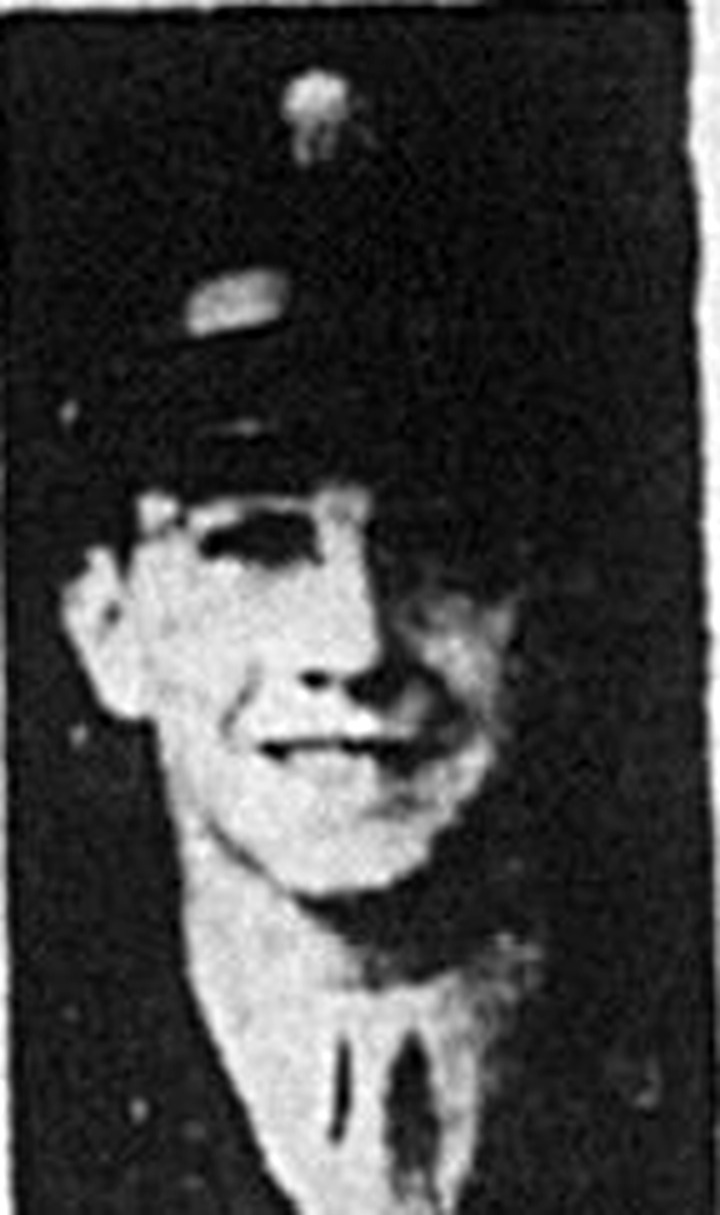
Portrait of Robert Earl Peacock in uniform
A World War II Service Record

Robert Earl Peacock

Technician Fifth Grade (T/5) · Troop A, 116th Cavalry Reconnaissance Squadron (Mechanized)
Army · Service no. 34 547 577
Service Number
34 547 577
Rank
Technician Fifth Grade (T/5)
Final Unit
Troop A, 116th Cavalry Reconnaissance Squadron (Mechanized)
MOS
776 - Radio Operator, Low Speed
This timeline follows Robert's World War II service through his enlistment record and the Morning Reports, orders and unit records held by the National Archives. Each entry identifies its source. Unit-history entries explain the setting of his service and distinguish unit events from actions documented for Robert personally.

By the Numbers

991
days in service

From entering active service on March 6, 1943 to discharge on November 21, 1945.

Source: National Archives, WWII Army Enlistment Records, 1938–1946, service number 34547577.; VA BIRLS Death File: selected-field transcription; VA grave marker shown below; Tracking the 101st: Troop A roster, roster compiled from Lieutenant Colonel Hubert C. Leonard’s papers.

Map of Service

Locations documented in Robert’s personal records, followed by his unit’s staging and travel. Connecting lines show the sequence of places rather than an exact travel route.
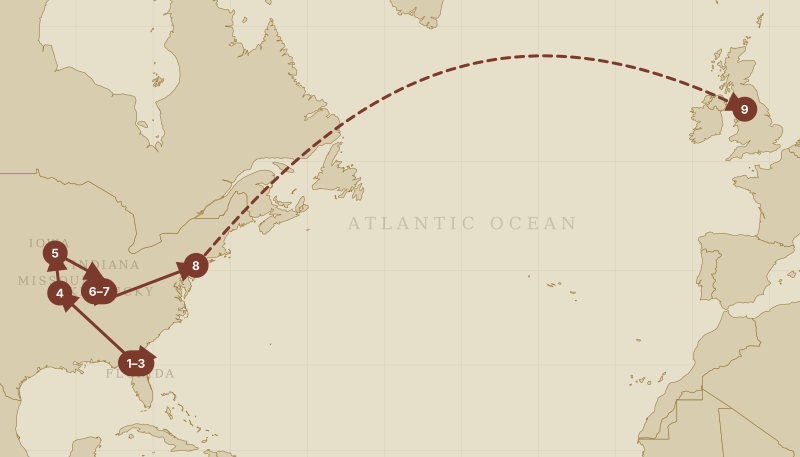
Map of locations in Robert Earl Peacock's personal records and unit history

Service stops

  1. Live Oak, Fla.born 1 Jan 1924
  2. Jacksonville, Fla.home; draft board, 1942
  3. Camp Blanding, Fla.enlisted 6 Mar 1943
  4. Fort Leonard Wood, Mo.575th Signal Co., 75th Inf Div
  5. Grinnell, IowaAST STAR Unit, Grinnell College
  6. Bloomington, Ind.1551st SU, ASTP, Indiana Univ.
  7. Camp Campbell, Ky.33rd, then 116th Cav Rcn Sq
  8. Camp Kilmer, N.J.Group staging, 26-30 Oct 1944
  9. Dalton-in-Furness, EnglandTroop A station, 1 Dec 1944

Route notes

  • 2 → 3Enlisted 6 Mar 1943
  • 3 → 4With the 575th Signal Company by Sept 1943
  • 4 → 5Ordered to the ASTP, 9 Nov 1943
  • 5 → 6Transfer effective 30 Nov 1943
  • 6 → 7Joined Troop D, 15 Mar 1944
  • 7 → 8The squadron stages for overseas, Oct 1944
  • 8 → 9Unit movement: Troop A at sea 6 Nov; in England 1 Dec 1944
First time here?

How to read this service timeline

This page brings together records created for different purposes. The labels below tell you what kind of evidence supports each entry; open either guide when a record or military term is unfamiliar.

Confirmed — Service record

A personal military record supports the entry.

Confirmed — Unit record

A record created by his unit names him or documents the unit’s activity.

Context

Helpful background, clearly separated from personal evidence.

Newly discovered

Information recovered during this research, rather than supplied at the start.

How to read a Morning Report

Morning Reports were daily administrative records prepared by individual Army and Army Air Forces units. They generally recorded changes—such as arrivals, transfers, promotions, illness, or return to duty—not a complete list of everyone present.
MORNING REPORT · SAMPLE
1Organization
Company A, 123rd Infantry
2Station or location
Camp Example, Virginia
3Date
14 September 1944
4Section
Personnel changes
5Pvt Smith, John A., 35123456
6asgd fr Hq Co per SO 187, Hq 123d Inf
In plain English Private John A. Smith, identified by Army Serial Number 35123456, was assigned to Company A from Headquarters Company under Special Orders No. 187.
  1. 1Organization: the company, hospital, squadron, or other unit filing the report.
  2. 2Station or location: where that unit reported from on that date.
  3. 3Report date: the date of the report, which may differ from the effective date of a change.
  4. 4Section: the part of the form containing personnel changes or the unit’s record of events.
  5. 5Soldier entry: usually rank, name, and Army Serial Number.
  6. 6Change and authority: what happened and the order authorizing it.
asgd
assigned
atchd
attached
trfd
transferred
fr
from
aptd
appointed
EM
enlisted men
SO
Special Orders
GO
General Orders
orgn
organization
sta
station
Common military and research terms
Army Serial Number (ASN)
The unique service number used to distinguish one soldier from others with similar names.
Discharge or separation paper
The document issued when a service member left active service. For many WWII Army enlisted soldiers, this is WD AGO Form 53-55. It summarizes service but is not a day-by-day history.
Morning Report
An Army unit’s daily administrative report. It usually lists people whose status changed, not every person in the unit.
Unit record
A document created by a military organization. It may name the soldier directly or provide context about his unit; the timeline states which applies.
OMPF or “201 file”
The service member’s Official Military Personnel File. Many Army and Air Force files were damaged or destroyed in the 1973 National Personnel Records Center fire.
Unit and final unit
A unit is the organization in which someone served. The final unit is the organization shown at separation; it may not be the only unit in the service history.
Rank or grade
The service member’s level in the military hierarchy. A timeline may show changes in rank over time.
MOS
Military Occupational Specialty—the Army’s classification for a soldier’s primary military job.
Assigned and attached
Assigned means formally placed in a unit. Attached usually means serving with a unit temporarily while belonging administratively elsewhere.
Special Orders and General Orders
Official directives used to authorize personnel actions, awards, organizational changes, and other decisions.
Campaign credit
Official recognition for service connected with a named campaign. It does not, by itself, describe a service member’s individual actions.
Station or location
The place from which a unit filed a report. It does not automatically prove that every member was physically present there.
Source citation
The note beneath a timeline entry identifying the record or records that support it.

Service Timeline

14 min
Confirmed — Record
January 1, 1924

Born in Live Oak, Suwannee County, Florida

Robert Earl Peacock was born on January 1, 1924, in Live Oak, Suwannee County, Florida. His June 1942 draft registration card gives his date and place of birth. His grave marker also gives January 1, 1924.
Source: Selective Service registration card, June 30, 1942, shown in the next entry; VA grave marker, shown at the end of this timeline.
Context
June 30, 1942

Registers for the draft

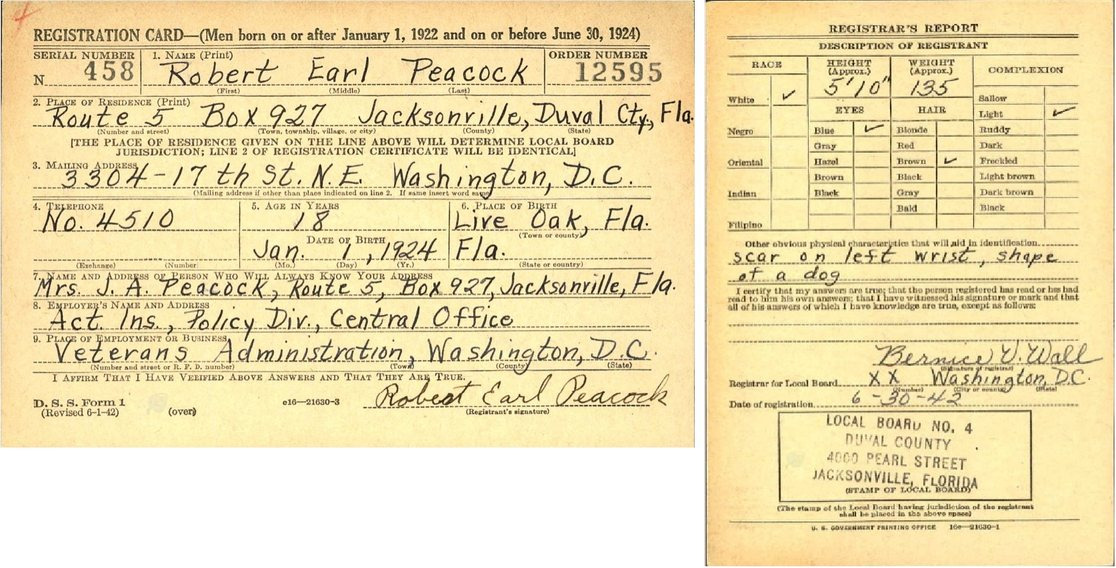
At eighteen, Robert registered for the draft. His card lists a Florida residence at Route 5, Box 927, Jacksonville and a mailing address at 3304 17th Street N.E., Washington, D.C. It names the Veterans Administration in Washington as his place of employment and abbreviates the office as Act. Ins. Policy Div. Central Office.

The card describes him as five feet ten inches tall and 135 pounds, with blue eyes, brown hair and a light complexion. It notes a scar on left wrist, shape of a dog. He named Mrs. J. A. Peacock of the Jacksonville address as the person who would always know his address. Local Board No. 4 in Duval County handled his registration.
scanned record
Both sides of his registration card, 30 June 1942.
Source: Selective Service registration card (D.S.S. Form 1), 30 June 1942, Local Board No. 4, Duval County, Florida
Confirmed — Service record
March 6, 1943

Enters the Army at Camp Blanding

The Army’s enlistment database dates Robert’s entry to March 6, 1943, at Camp Blanding, Florida. It lists him as a Private and a selectee, a man entering through the draft, with service number 34 547 577.

The entry lists four years of high school, a civilian occupation in the stenographer and typist category, and residence in the District of Columbia.
Context
June 27, 1943

Three brothers, three stars in the window

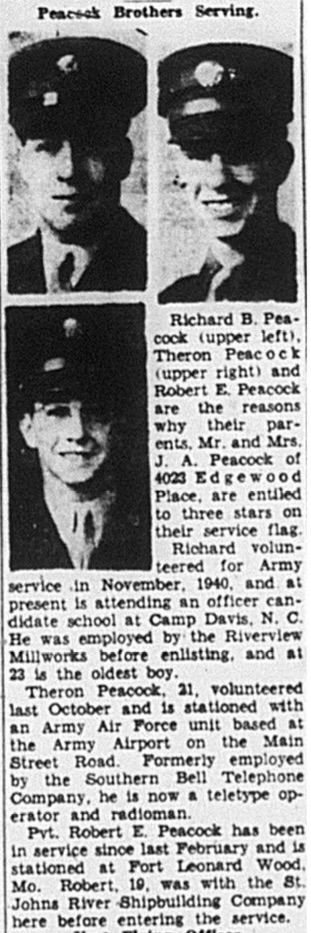
A newspaper feature titled Peacock Brothers Serving pictured Robert and his two older brothers. It placed nineteen-year-old Robert at Fort Leonard Wood, Missouri, and said he had worked for the St. Johns River Shipbuilding Company before entering the Army.

Richard was attending officer candidate school at Camp Davis, North Carolina. Theron was serving as a teletype operator and radioman with an Army Air Forces unit in Jacksonville. Their parents, Mr. and Mrs. J. A. Peacock, could display three stars on the family service flag, one for each son serving.

The copy preserved on Robert’s cemetery memorial is identified as the Florida Times-Union of June 27, 1943.
scanned record
Richard upper left, Theron upper right, Robert below. The yellow is ours — it marks his name and service number on the sheet.
Source: “Peacock Brothers Serving”, newspaper clipping shown here; newspaper and date attributed by the contributor of the copy on Find A Grave memorial 140427398.
Confirmed — Unit record
September 9, 1943

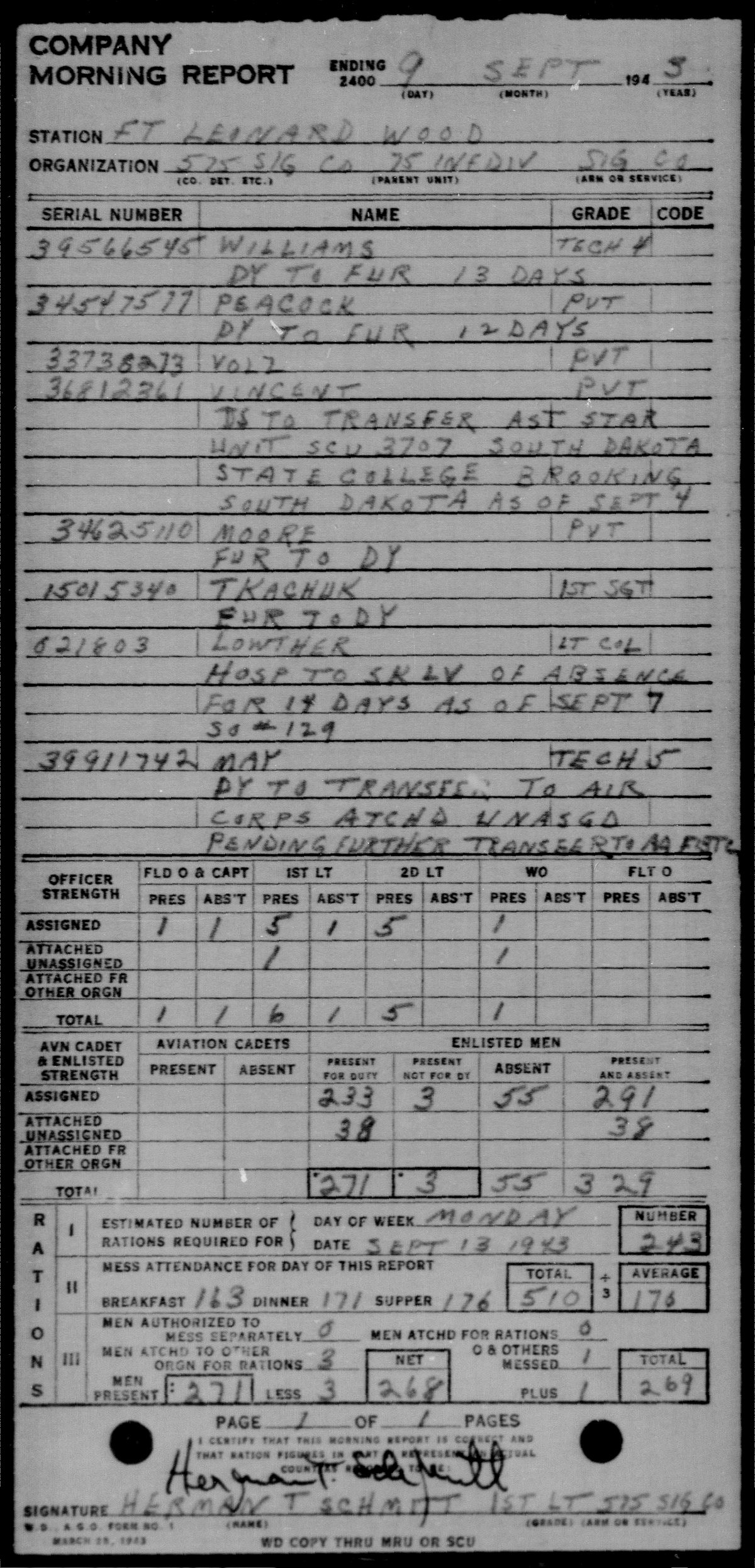
Twelve days’ furlough from Fort Leonard Wood

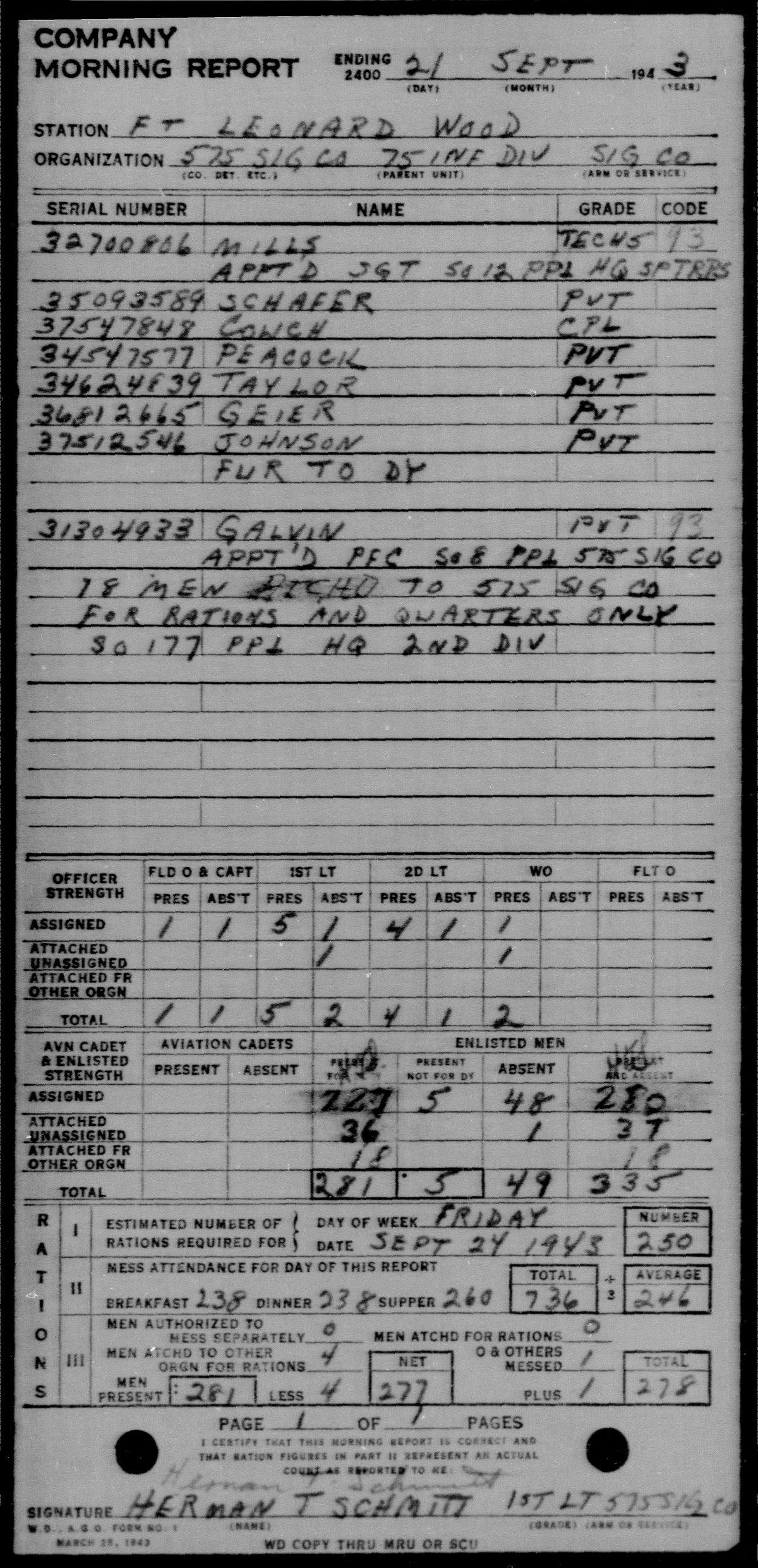
While serving with the 575th Signal Company at Fort Leonard Wood, Robert received twelve days of furlough, or military leave, beginning September 9. The company’s September 21 morning report lists him returning to duty.

A morning report is a unit’s daily record of changes in its soldiers’ status.
scanned record
9 September 1943: ‘Dy to fur 12 days’, on the line below his name. The yellow is ours — it marks his name and service number on the sheet.
scanned record
September 21, 1943: Robert is among the men returning from furlough to duty. The yellow is ours — it marks his name and service number on the sheet.
Source: Morning Report — 575th Signal Company, 75th Infantry Division, Fort Leonard Wood, Mo. — NARA NAID 449922372, Roll 206, images 1103 and 1119, 9 and 21 September 1943
Confirmed — Unit record
September 23, 1943

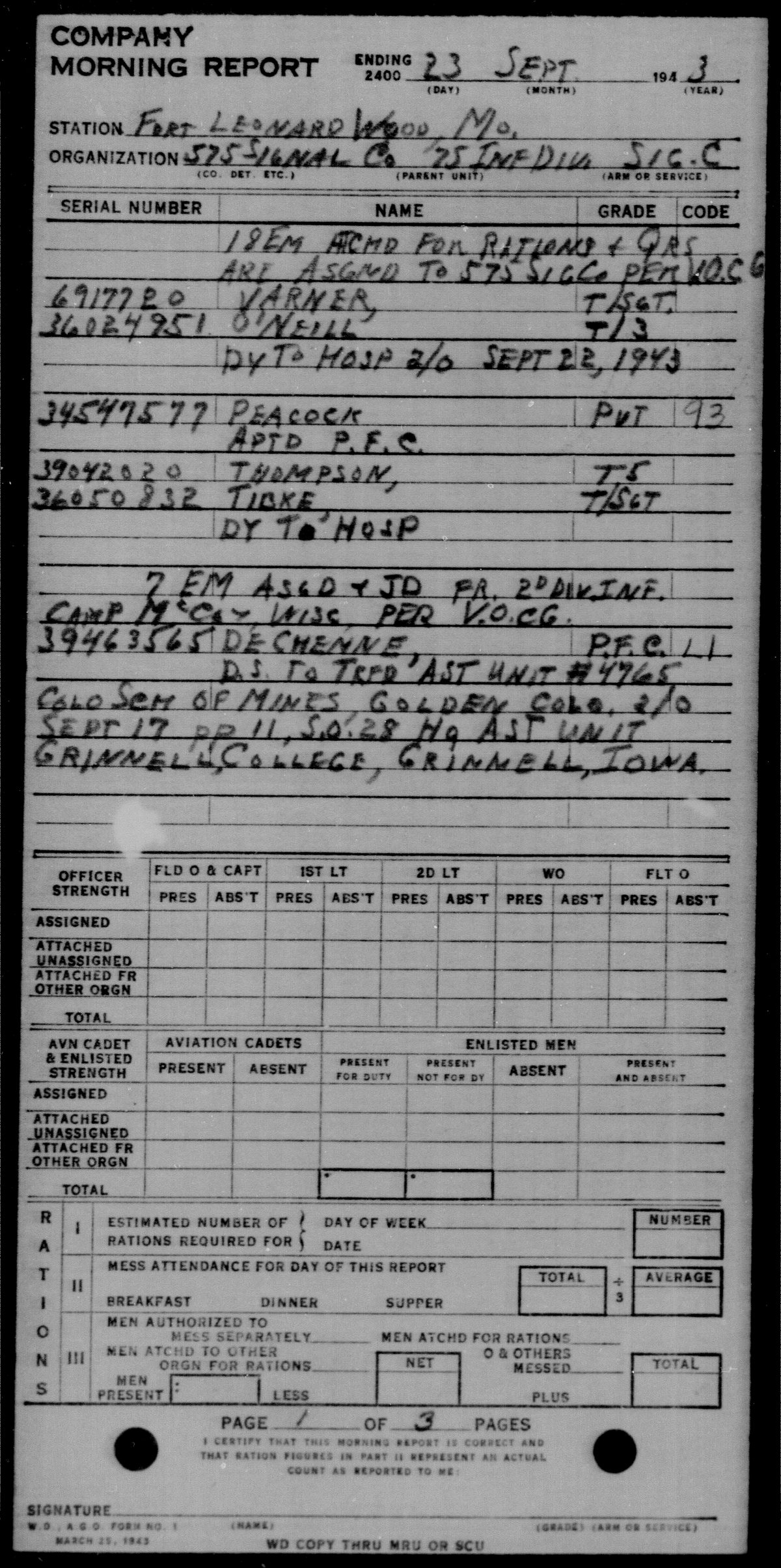
Fort Leonard Wood — made Private First Class

The 575th Signal Company, part of the 75th Infantry Division at Fort Leonard Wood, appointed Robert a Private First Class. His name and service number appear beside the notation Aptd P.F.C., meaning appointed Private First Class.
scanned record
Company Morning Report, 575th Signal Company, 23 September 1943. The yellow is ours — it marks his name and service number on the sheet.
Source: Morning Report — 575th Signal Company, 75th Infantry Division — NARA NAID 449922372, Roll 206, image 1122, 23 September 1943
Confirmed — Unit record
November 9, 1943

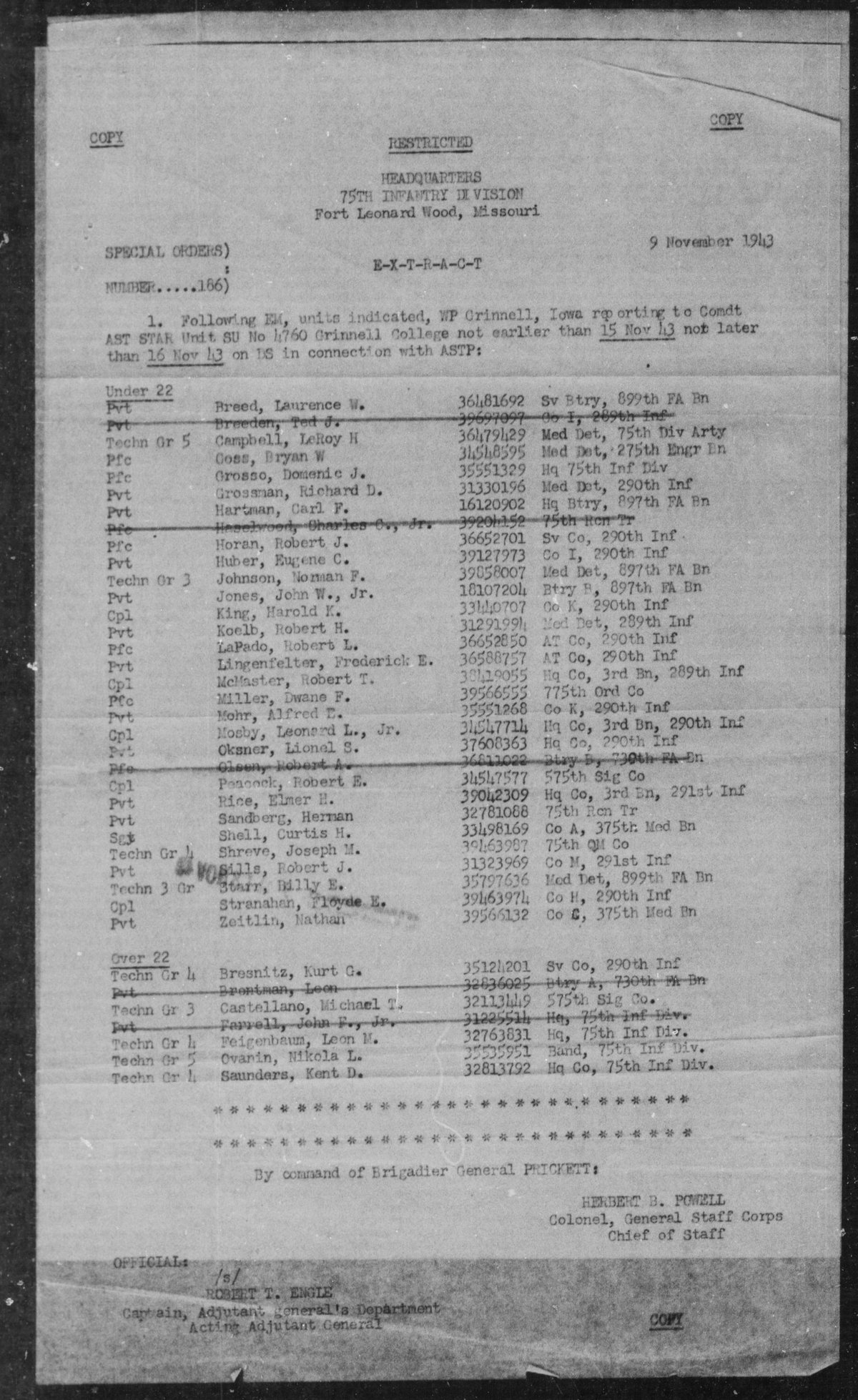
Selected for Army college training

By November 9, Robert was listed as a Corporal. Special Orders No. 186 directed him to report to the Army Specialized Training Program’s selection and placement unit at Grinnell College, Iowa, on November 15 or 16.

The Army Specialized Training Program sent selected soldiers to colleges for instruction intended to support military needs. These orders establish Robert’s selection; they do not identify a particular college subject for him.
scanned record
Special Orders No. 186, HQ 75th Infantry Division, Fort Leonard Wood, 9 November 1943. The yellow is ours — it marks his name and service number on the sheet.
Source: Special Orders No. 186, Headquarters, 75th Infantry Division, November 9, 1943 — NARA NAID 455190523, Roll 57, image 433.
Confirmed — Unit record
November 30, 1943

Grinnell College, Iowa — and on to Indiana

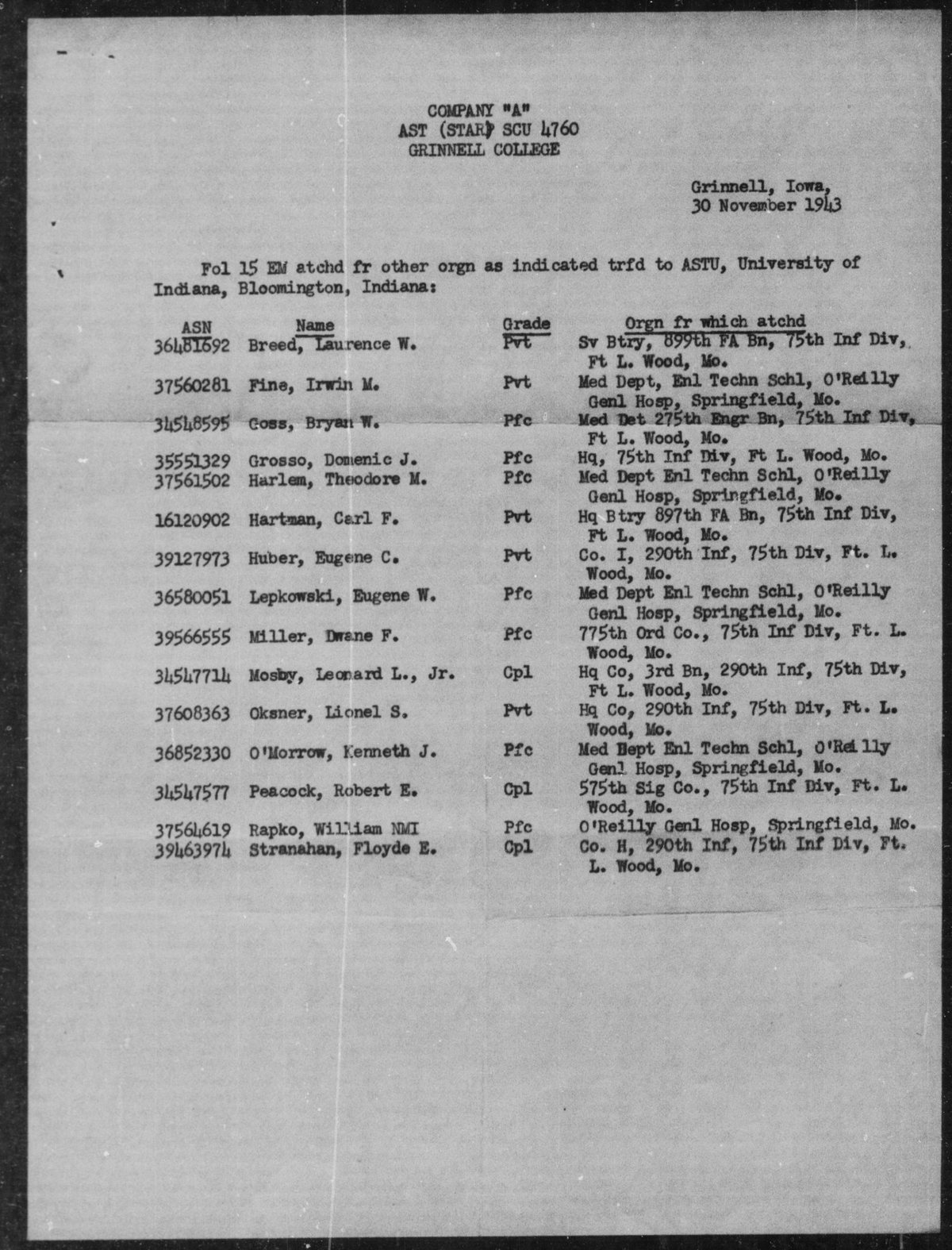
Grinnell’s November 30 roster lists Robert among the men being sent to Indiana University in Bloomington. It identifies his previous unit as the 575th Signal Company and lists him as a Corporal.

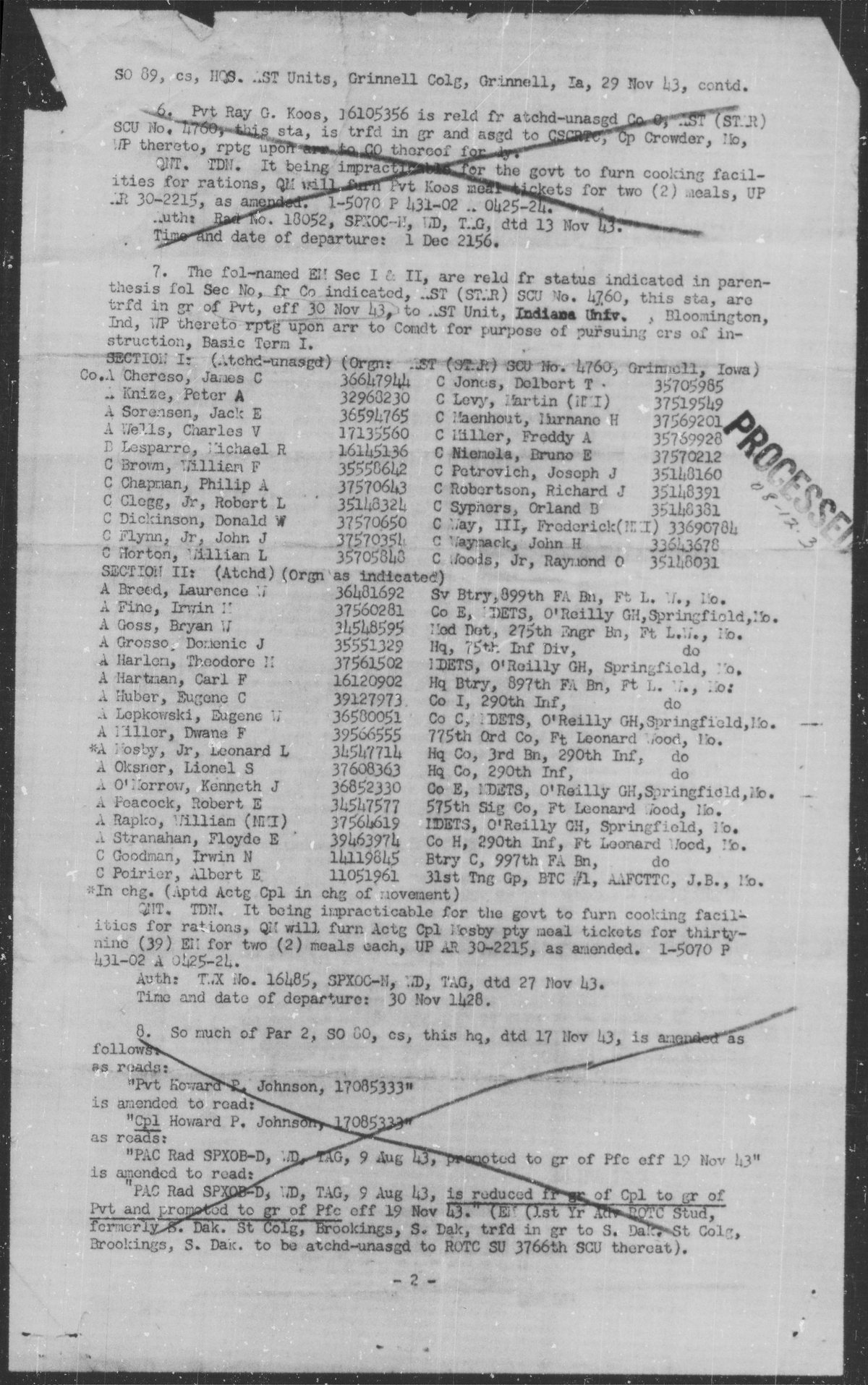
The transfer order, issued November 29 and effective November 30, assigned him to Indiana University’s Army training unit in grade of Pvt, or Private, to begin Basic Term I. The roster and order document the move from the selection unit at Grinnell to university training in Indiana.
scanned record
The Grinnell College roster, 30 November 1943. The yellow is ours — it marks his name and service number on the sheet.
scanned record
Special Orders No. 89, Hq AST Units, Grinnell College, 29 November 1943, paragraph 7: his line is in Section II. The yellow is ours — it marks his name and service number on the sheet.
Source: Company A, Army Specialized Training selection unit, Grinnell College, roster dated November 30, 1943 — NARA NAID 455190523, Roll 57, image 462; Special Orders No. 89, Headquarters Army Specialized Training Units, Grinnell College, November 29, paragraph 7 — NARA NAID 458286620, Roll 208, image 41.
Confirmed — Unit record
December 3, 1943

Indiana University: training as a Private

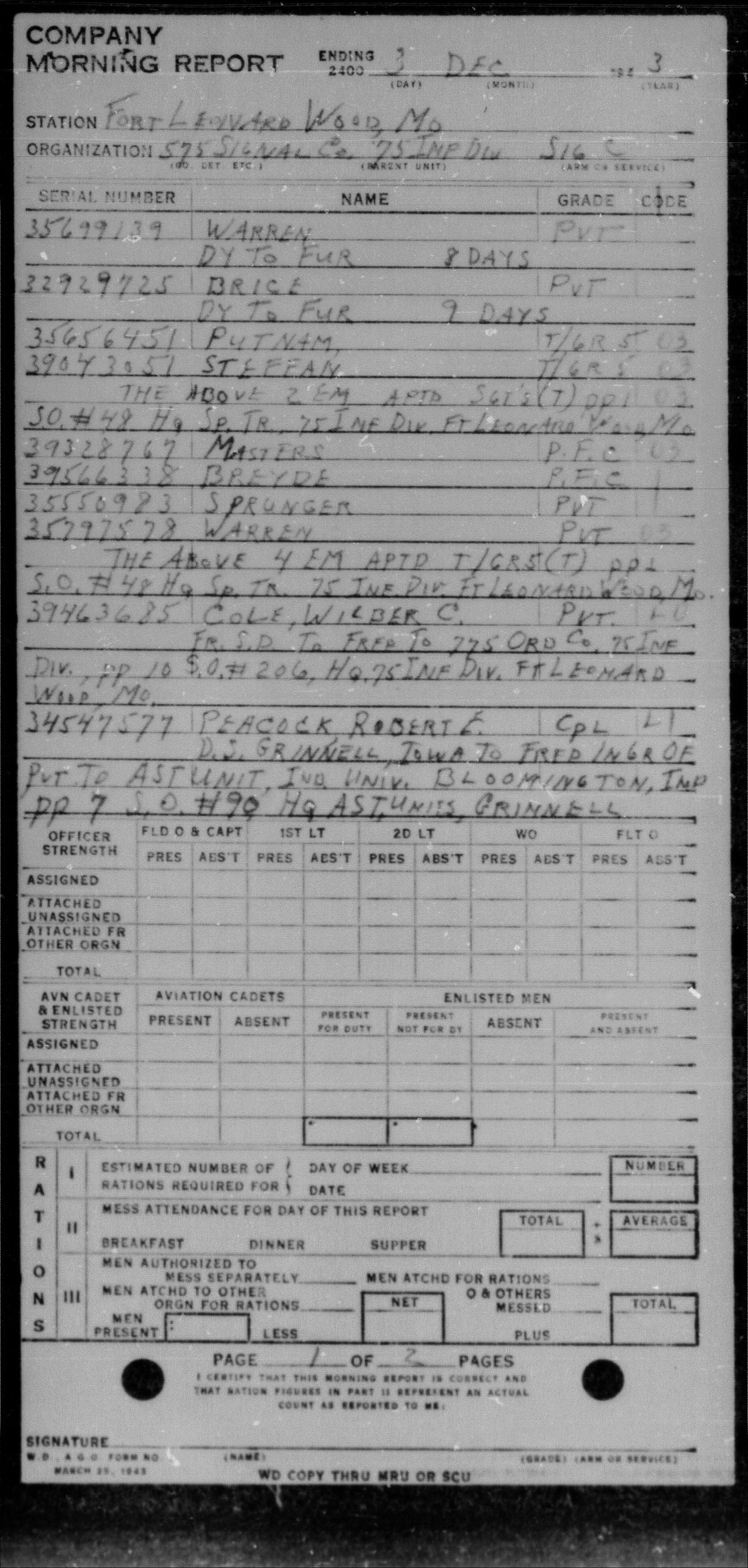
The 575th Signal Company’s December 3 morning report documented Robert’s transfer from detached service at Grinnell to the Army training unit at Indiana University, in the grade of Private. This was the company’s record of the transfer ordered effective November 30.
scanned record
Company Morning Report, 575th Signal Company, 3 December 1943. The yellow is ours — it marks his name and service number on the sheet.
Source: Morning Report — 575th Signal Company, 75th Infantry Division — NARA NAID 458712409, Roll 345, image 42, December 3, 1943.
Confirmed — Unit record
December 1943

A stay in the station hospital

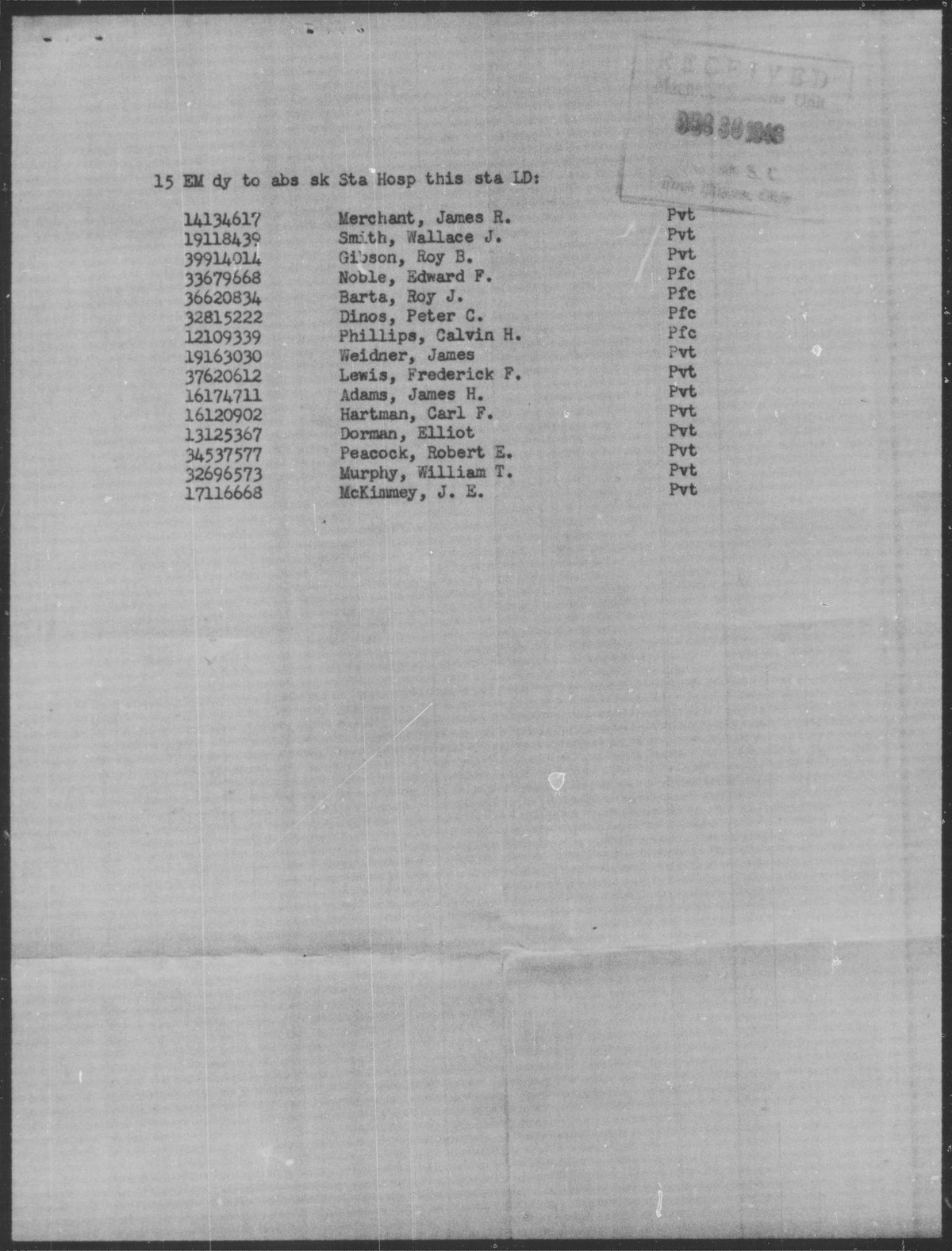
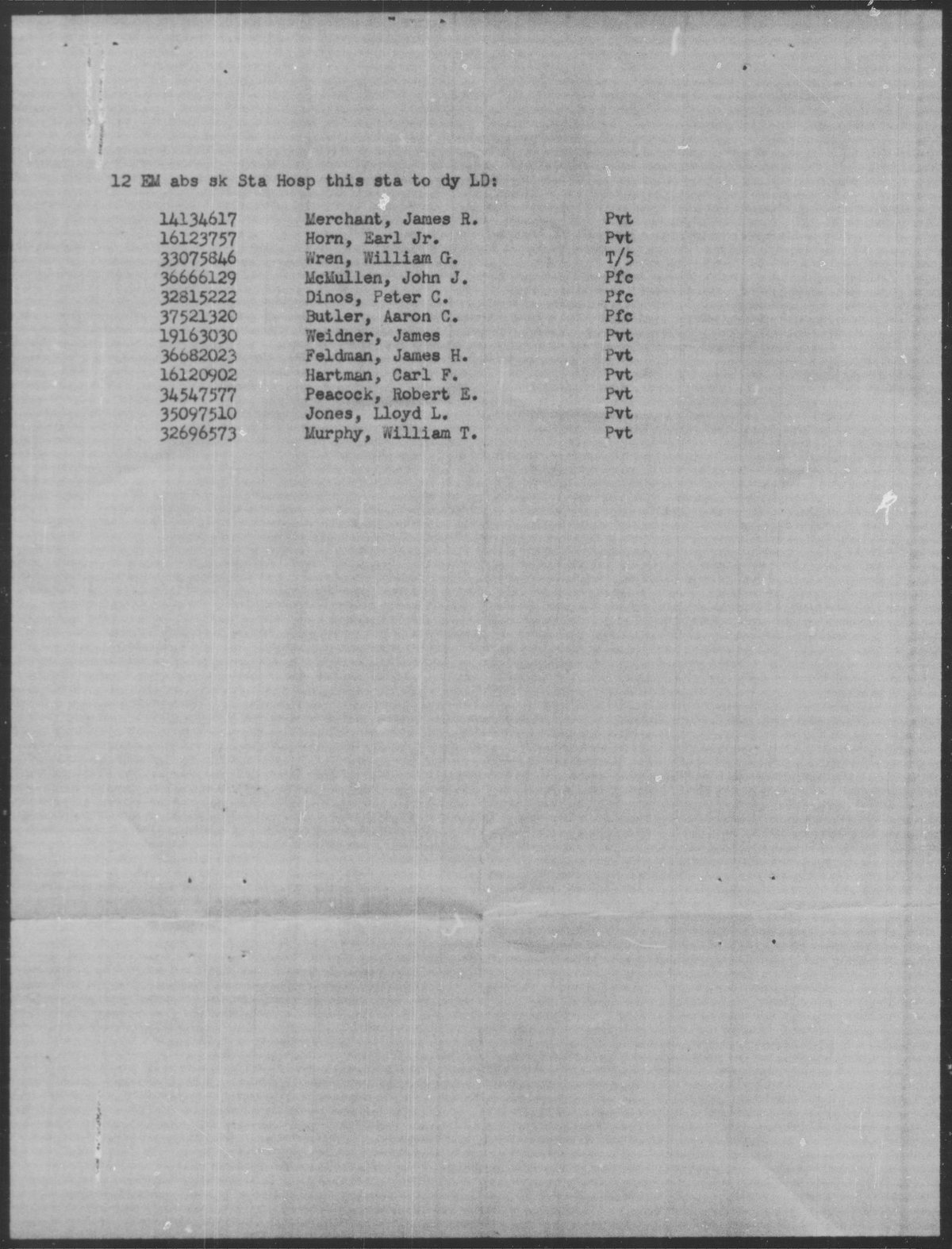
The 1551st Service Unit’s report for 27 December 1943 lists fifteen men dy to abs sk Sta Hosp this sta LD: from duty to the station hospital, in line of duty. The thirteenth line reads Peacock, Robert E., Pvt.

A continuation filed later in the same December reports lists twelve men returning from the station hospital to duty. It gives his name, Peacock, Robert E., his rank of Private, and his service number. Eight of the names appear on both lists.
scanned record
27 December 1943: fifteen men from duty to the station hospital; his line is the thirteenth. The yellow is ours — it marks his name and service number on the sheet.
scanned record
Return-to-duty continuation: Peacock, Robert E., Private. The yellow is ours — it marks his name and service number on the sheet.
Source: Morning Report — Headquarters, 1551st Service Unit, ASTU, Indiana University, Bloomington — NARA NAID 458286620, Roll 208, image 279, 27 December 1943; and NARA NAID 458286620, Roll 208, image 293, a continuation in the same December 1943 sequence that does not print its own date.
Confirmed — Unit record
March 4, 1944

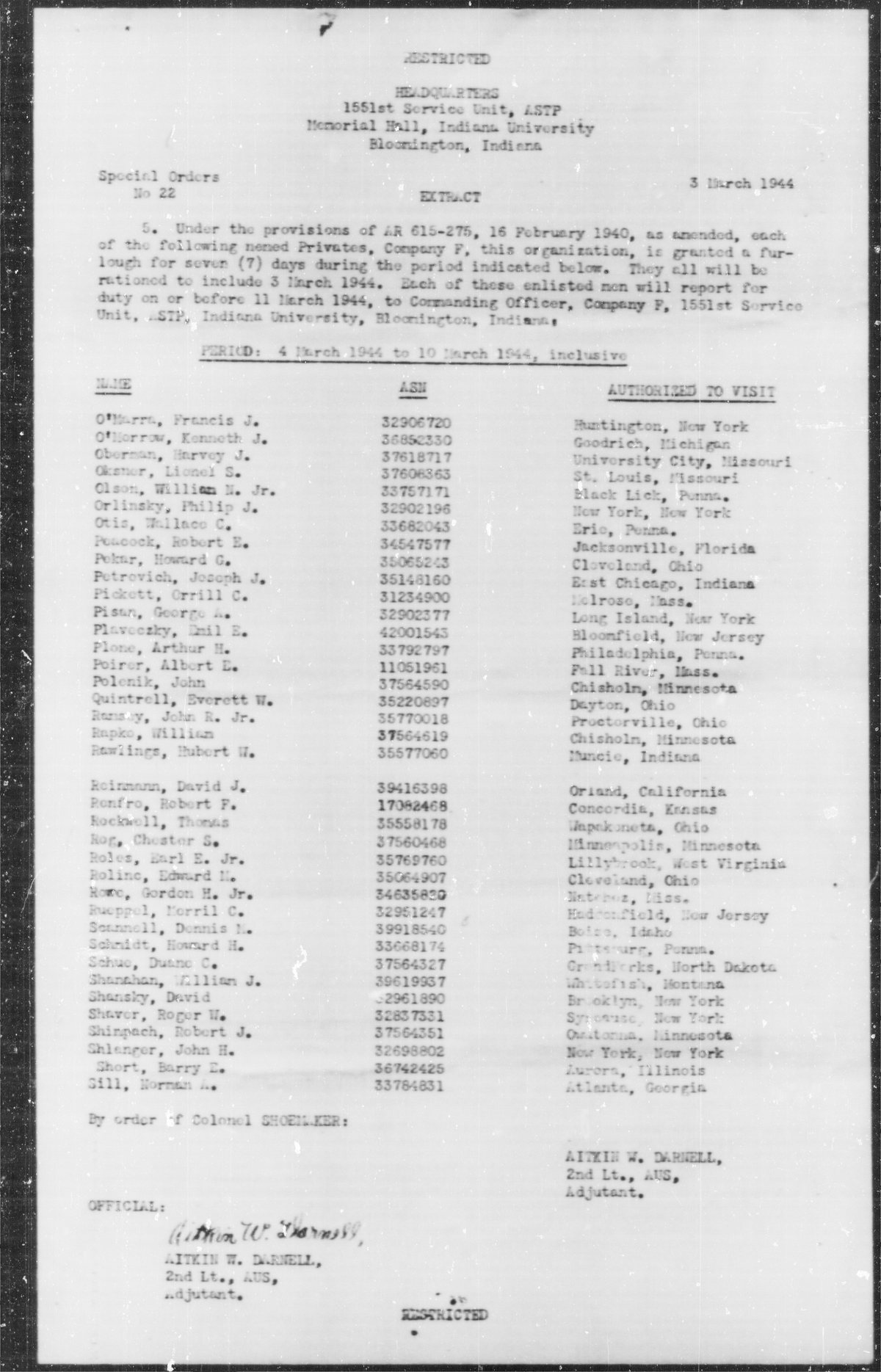
Leave authorized for Jacksonville

Special Orders No. 22, issued at Indiana University on March 3, authorized Robert a seven-day furlough from March 4 through March 10. Beside his name and service number, the order lists Jacksonville, Florida as his destination.
scanned record
Special Orders No. 22, 3 March 1944 — the furlough list, with his destination typed beside his number. The yellow is ours — it marks his name and service number on the sheet.
Source: Special Orders No. 22, Headquarters, 1551st Service Unit, Indiana University, March 3, 1944 — NARA NAID 465785410, Roll 326, image 116.
Confirmed — Unit record
March 14, 1944

Camp Campbell, Kentucky — Troop D, and a clerk’s job

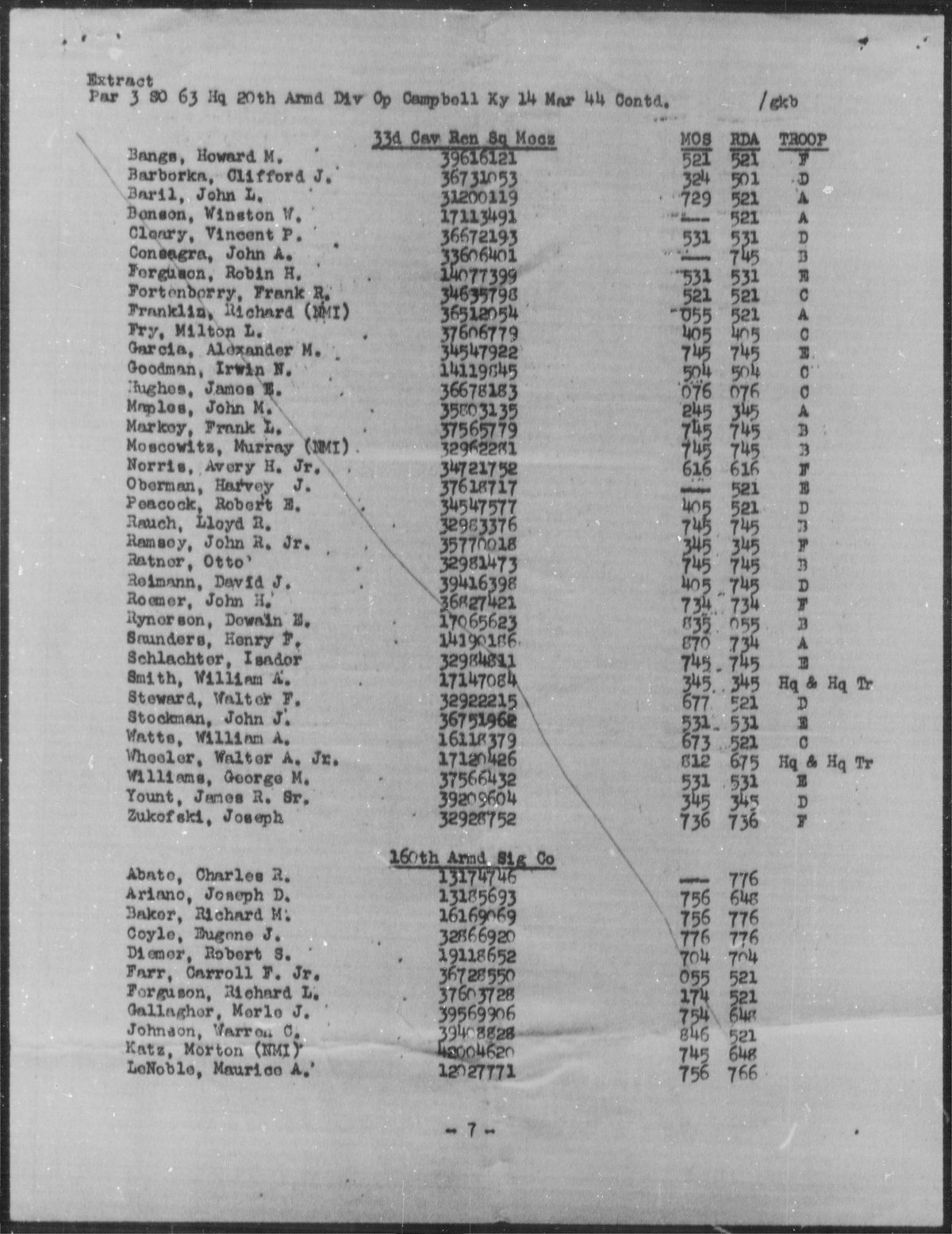
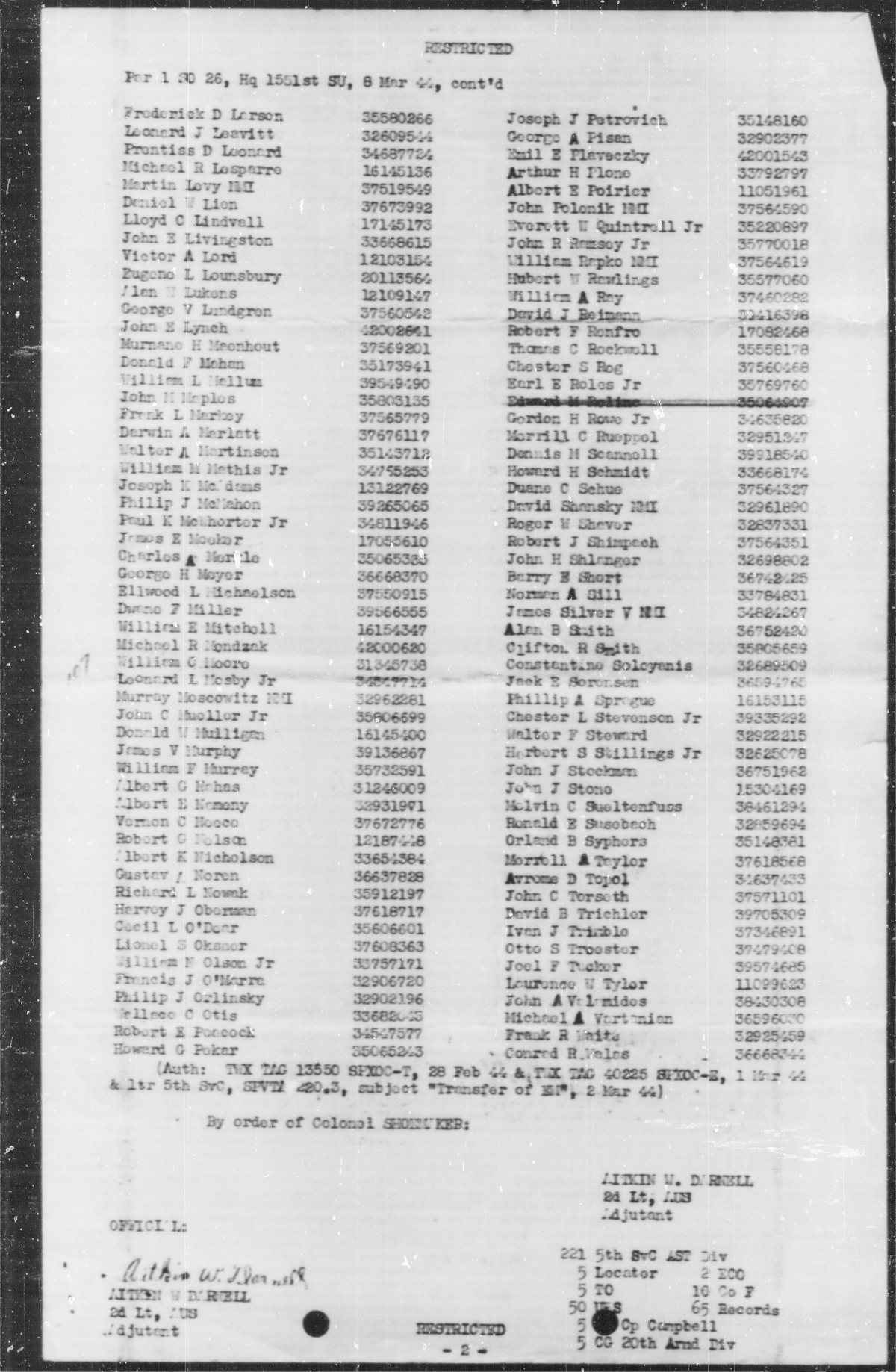
As the Army sharply reduced its college training program in early 1944, Robert was assigned to Troop D, 33rd Cavalry Reconnaissance Squadron, part of the 20th Armored Division at Camp Campbell, Kentucky.

The division’s March 14 assignment list places him in Troop D with military job code 405, Clerk-Typist. His March 8 transfer order from Indiana University is also shown here. The clerk-typist assignment was consistent with the civilian occupation category listed in his enlistment entry.
scanned record
The 20th Armored Division roster, 14 March 1944 — name, number, specialty, troop. The yellow is ours — it marks his name and service number on the sheet.
scanned record
The 1551st Service Unit’s transfer roster, with his name and number among the ASTP students. The yellow is ours — it marks his name and service number on the sheet.
Source: Special Orders No. 63, Headquarters, 20th Armored Division, March 14, 1944, paragraph 3 — NARA NAID 465699924, Roll 294, image 761; Special Orders No. 26, Headquarters, 1551st Service Unit, March 8, 1944 — NARA NAID 465785410, Roll 326, image 138. Program reduction: U.S. Army Medical Department history, chapter II. Job-code definition: War Department, TM 12-427, Military Occupational Classification of Enlisted Personnel, PDF pages 111.
Confirmed — Unit record
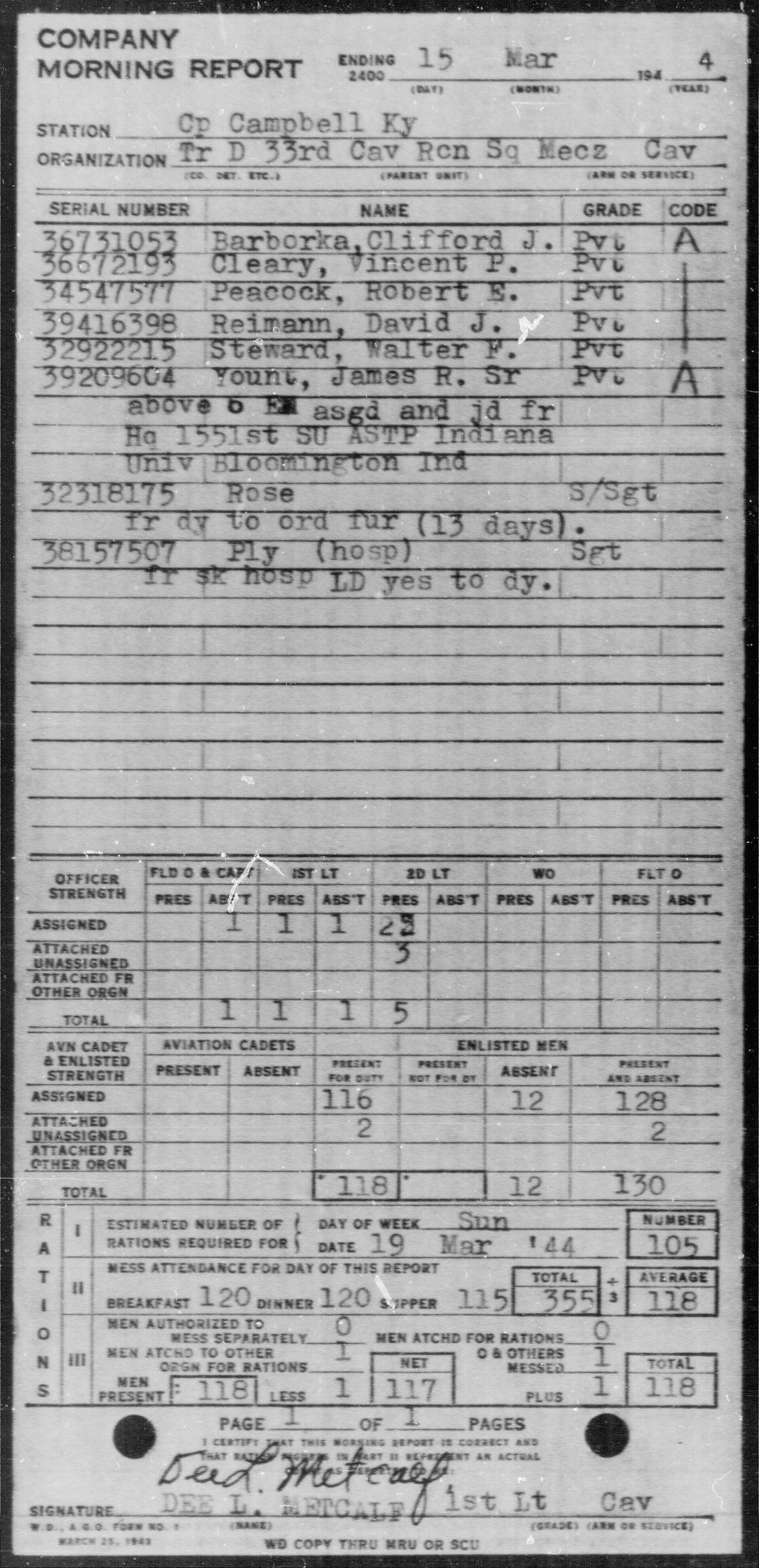
March 15, 1944

Reports to the 33rd Cavalry Reconnaissance Squadron

Troop D’s March 15 morning report lists Robert as assigned and joined from Indiana University’s Army training unit. This entry confirms his arrival at Camp Campbell with the 33rd Cavalry Reconnaissance Squadron.

In a mechanized cavalry unit, soldiers used vehicles for scouting and reconnaissance: gathering information about terrain and opposing forces.
scanned record
Company Morning Report, Troop D, 33rd Cavalry Reconnaissance Squadron, 15 March 1944. The yellow is ours — it marks his name and service number on the sheet.
Source: Morning Report — Troop D, 33rd Cavalry Reconnaissance Squadron (Mecz), Camp Campbell, Kentucky — NARA NAID 465697115, Roll 293, image 182, 15 March 1944
Confirmed — Unit record
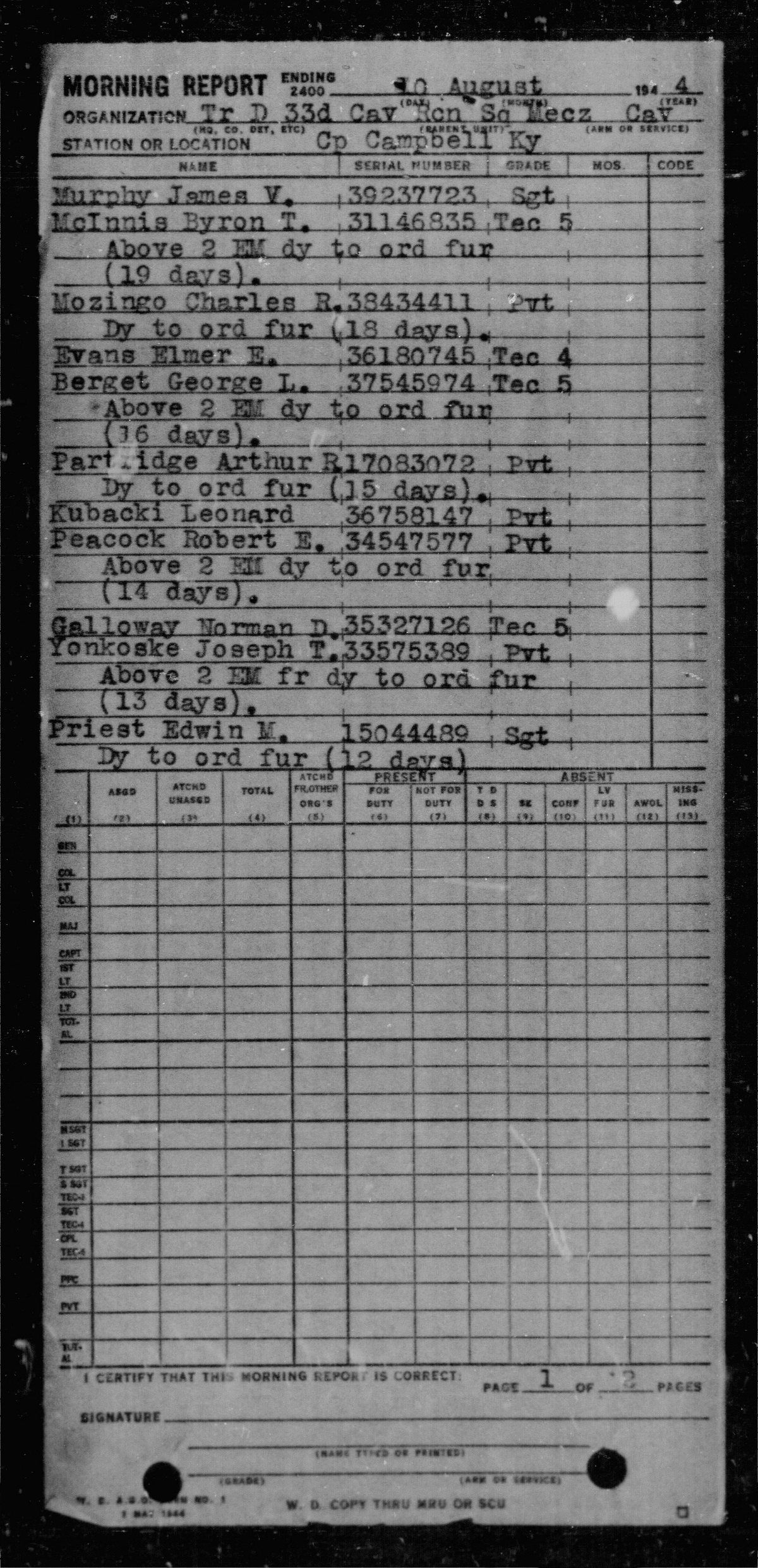
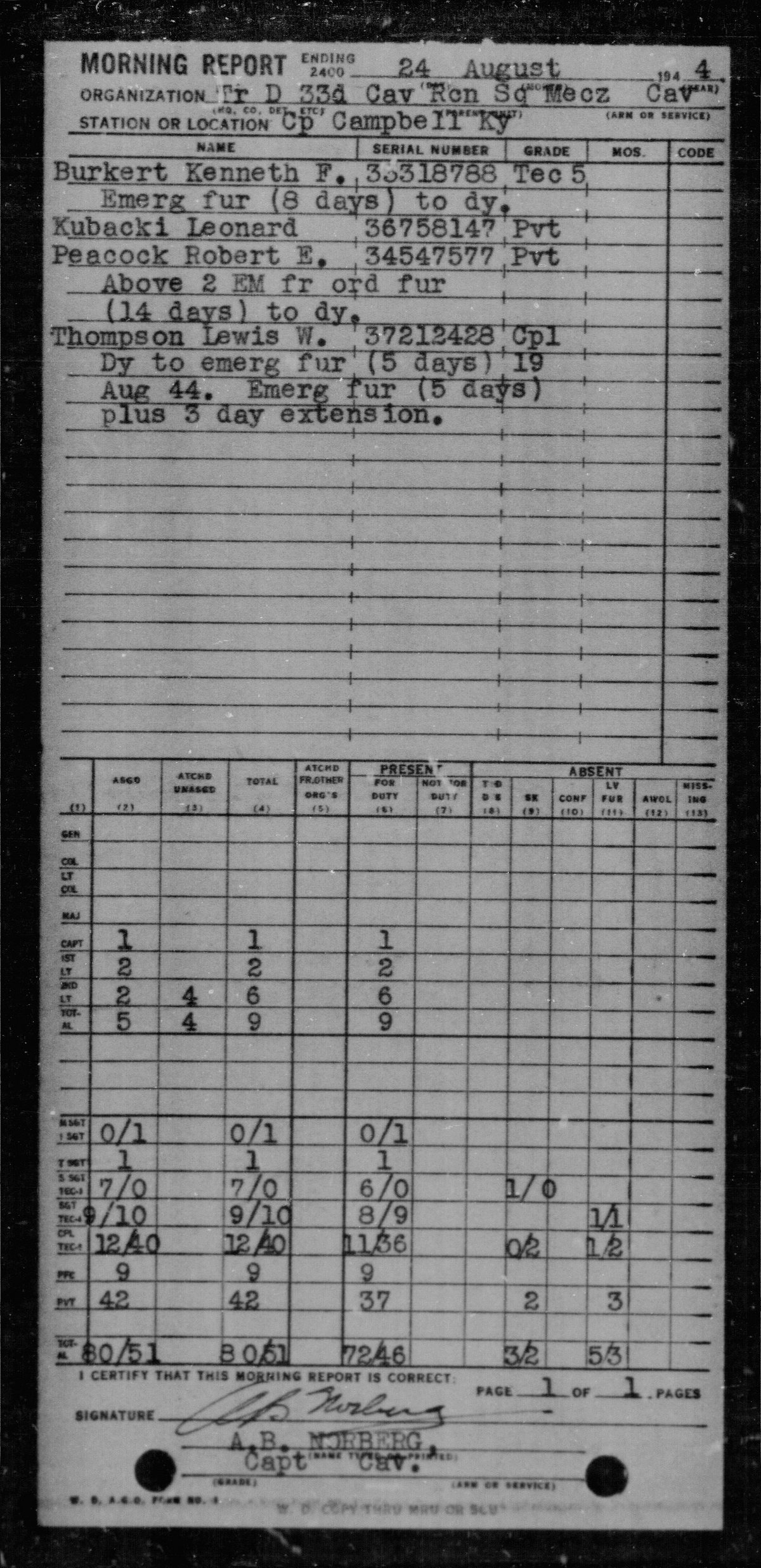
August 10, 1944

Fourteen days’ furlough

Troop D granted Robert fourteen days of furlough beginning August 10. Its August 24 morning report lists him returning to duty. Both pages identify him by name and service number.
scanned record
Morning Report, 10 August 1944 — fourteen days’ furlough. The yellow is ours — it marks his name and service number on the sheet.
scanned record
Morning Report, 24 August 1944 — back to duty. The yellow is ours — it marks his name and service number on the sheet.
Source: Morning Report — Troop D, 33rd Cavalry Reconnaissance Squadron (Mecz) — NARA NAID 564597368, Roll 58, images 3707 and 3722, 10 and 24 August 1944
Confirmed — Unit record
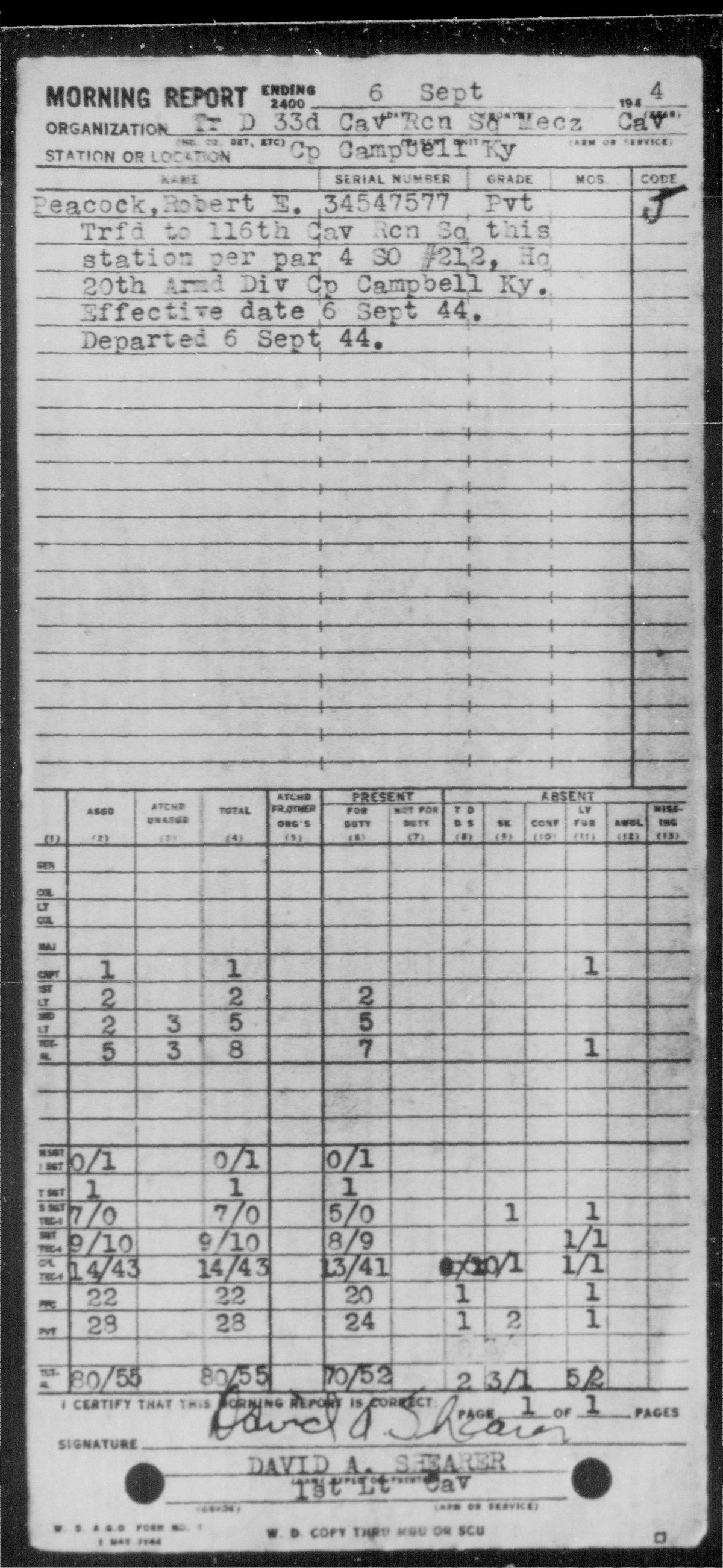
September 6, 1944

Transferred to the 116th Cavalry Reconnaissance Squadron

Troop D’s morning report documented Robert’s transfer from the 33rd to the 116th Cavalry Reconnaissance Squadron at Camp Campbell, effective September 6. It gives the same date for his departure. The receiving troop’s report, shown next, confirms his arrival with the new squadron.
scanned record
Company Morning Report, Troop D, 6 September 1944 — his transfer out. The yellow is ours — it marks his name and service number on the sheet.
Source: Morning Report — Troop D, 33rd Cavalry Reconnaissance Squadron (Mecz) — NARA NAID 568488292, Roll 231, image 1911, 6 September 1944
Confirmed — Unit record
September 6, 1944

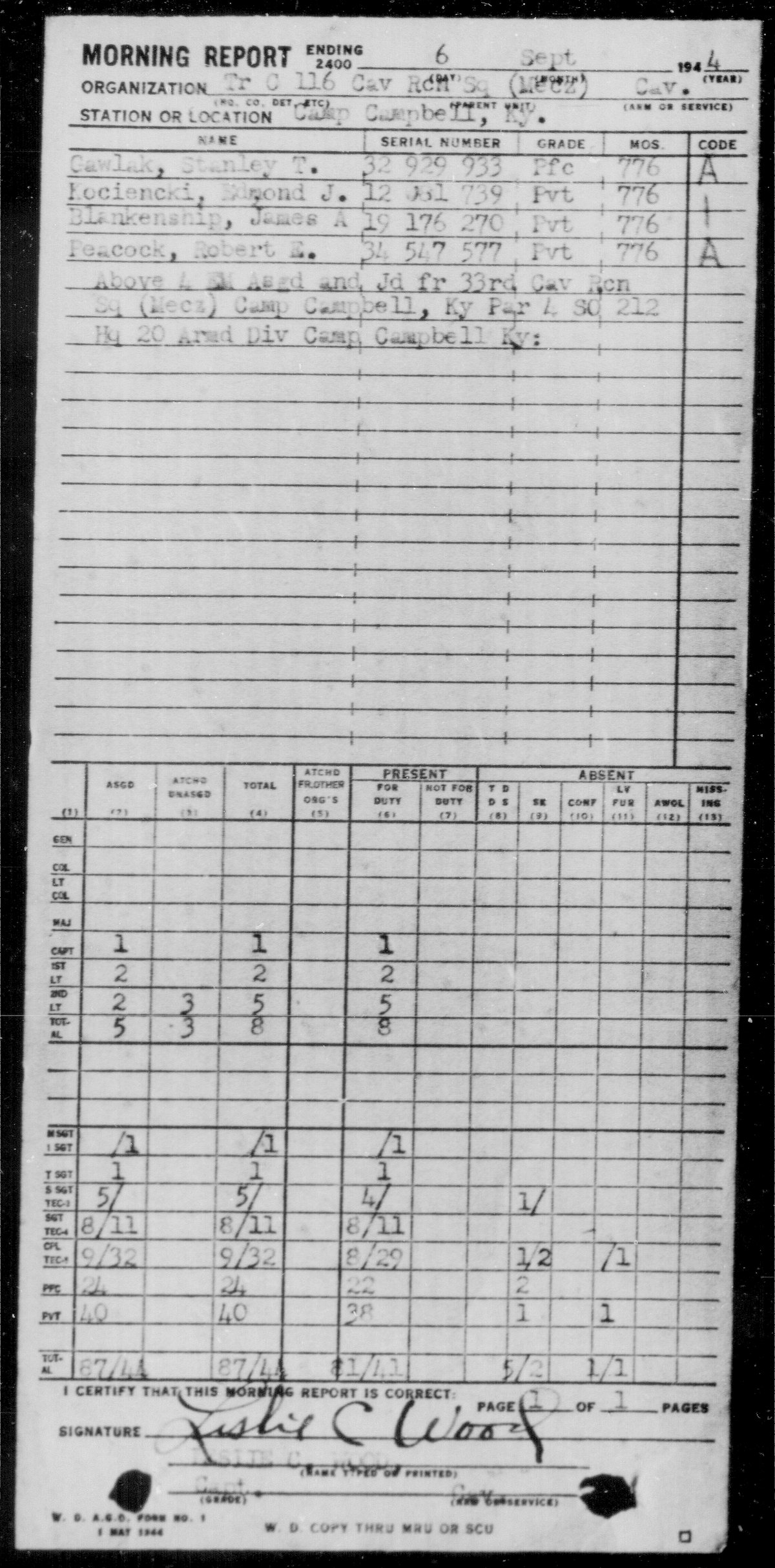
Troop C, 116th Cavalry Reconnaissance Squadron

Troop C of the 116th Cavalry Reconnaissance Squadron listed Robert as assigned and joined from the 33rd Squadron on September 6.

His military job code was now 776, Radio Operator, Low Speed, rather than the clerk-typist code shown in March. The entry establishes his radio-operator assignment in the new unit.
scanned record
Morning Report, Troop C, 116th Cavalry Reconnaissance Squadron, 6 September 1944 — his line is the fourth. The yellow is ours — it marks his name and service number on the sheet.
Source: Morning Report — Troop C, 116th Cavalry Reconnaissance Squadron (Mecz) — NARA NAID 568491563, Roll 232, image 1559, 6 September 1944 Job-code definition: War Department, TM 12-427, Military Occupational Classification of Enlisted Personnel, PDF pages 53 and 156–157.
Confirmed — Unit record
September 18, 1944

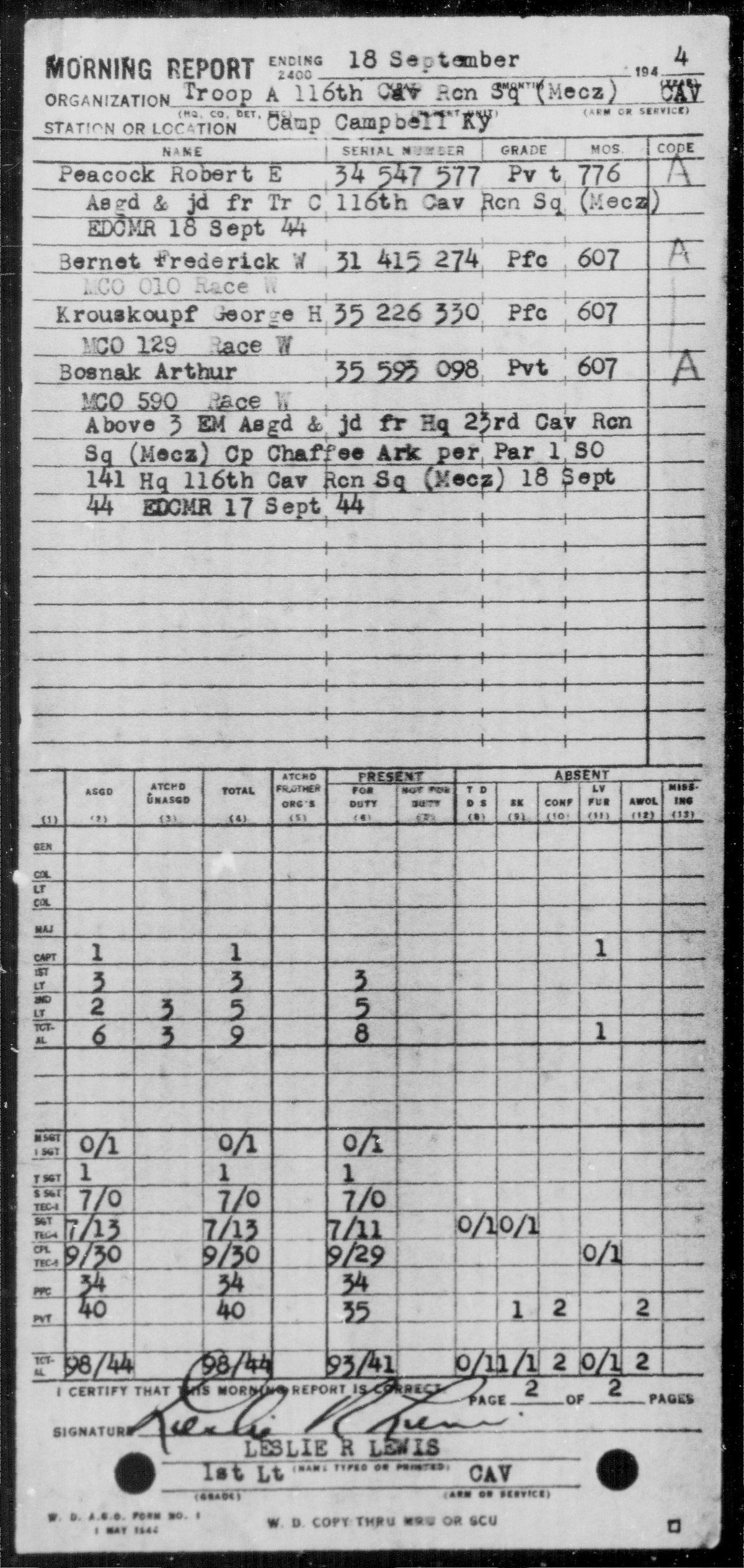
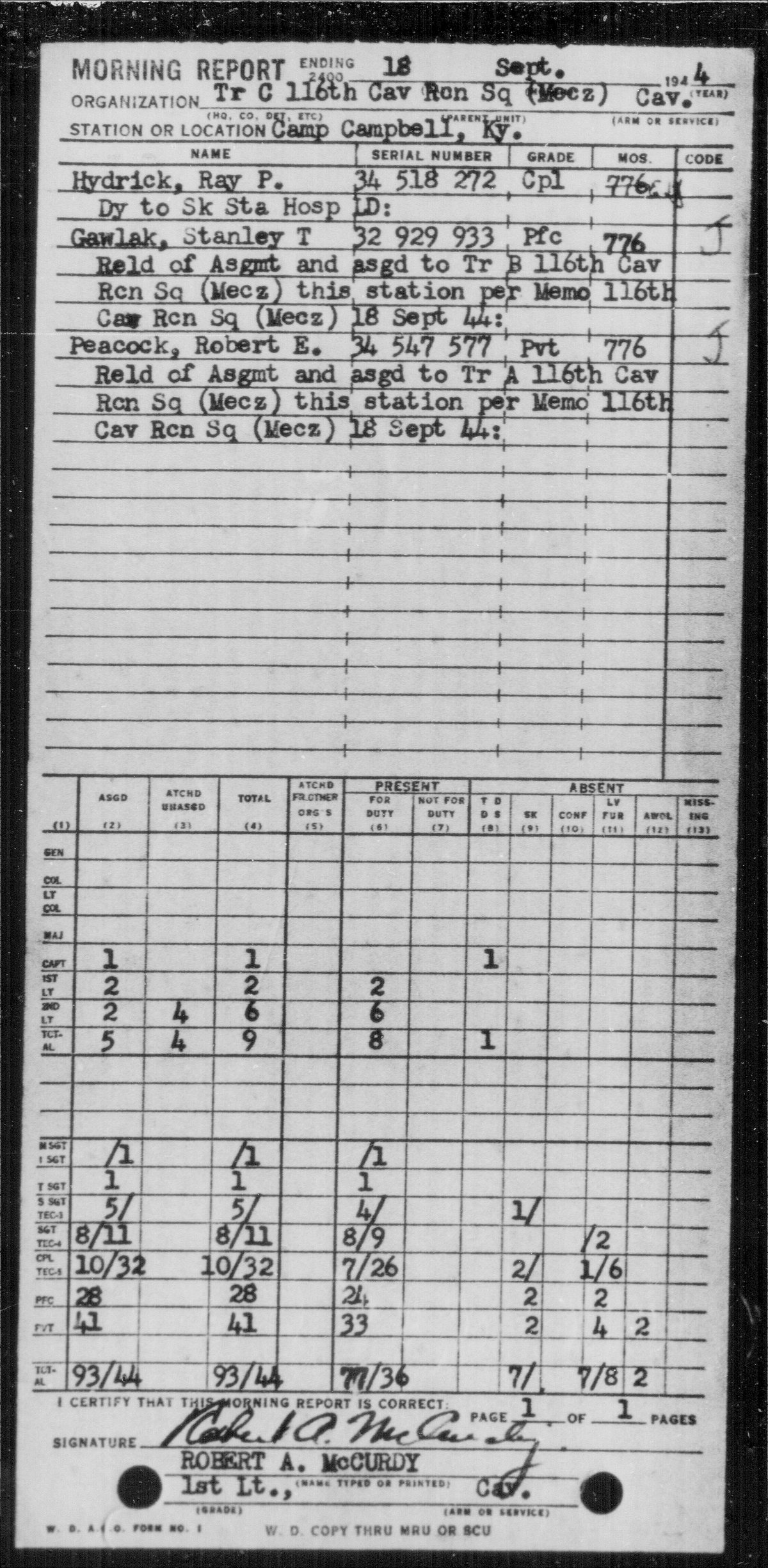
Assigned to Troop A

The squadron transferred Robert from Troop C to Troop A on September 18. Troop C’s report releases him, and Troop A’s report lists him as assigned and joined from Troop C.

Both reports show his name and service number. Troop A lists his rank as Private and his military job code as 776, Radio Operator, Low Speed.
scanned record
Troop A’s report, 18 September 1944 — his is the first line. The yellow is ours — it marks his name and service number on the sheet.
scanned record
Troop C’s report the same day, releasing him. The yellow is ours — it marks his name and service number on the sheet.
Source: Morning Report — Troop A and Troop C, 116th Cavalry Reconnaissance Squadron (Mecz) — NARA NAID 568491563, Roll 232, images 1506 and 1575, 18 September 1944 Job-code definition: War Department, TM 12-427, Military Occupational Classification of Enlisted Personnel, PDF pages 53 and 156–157.
Confirmed — Unit record
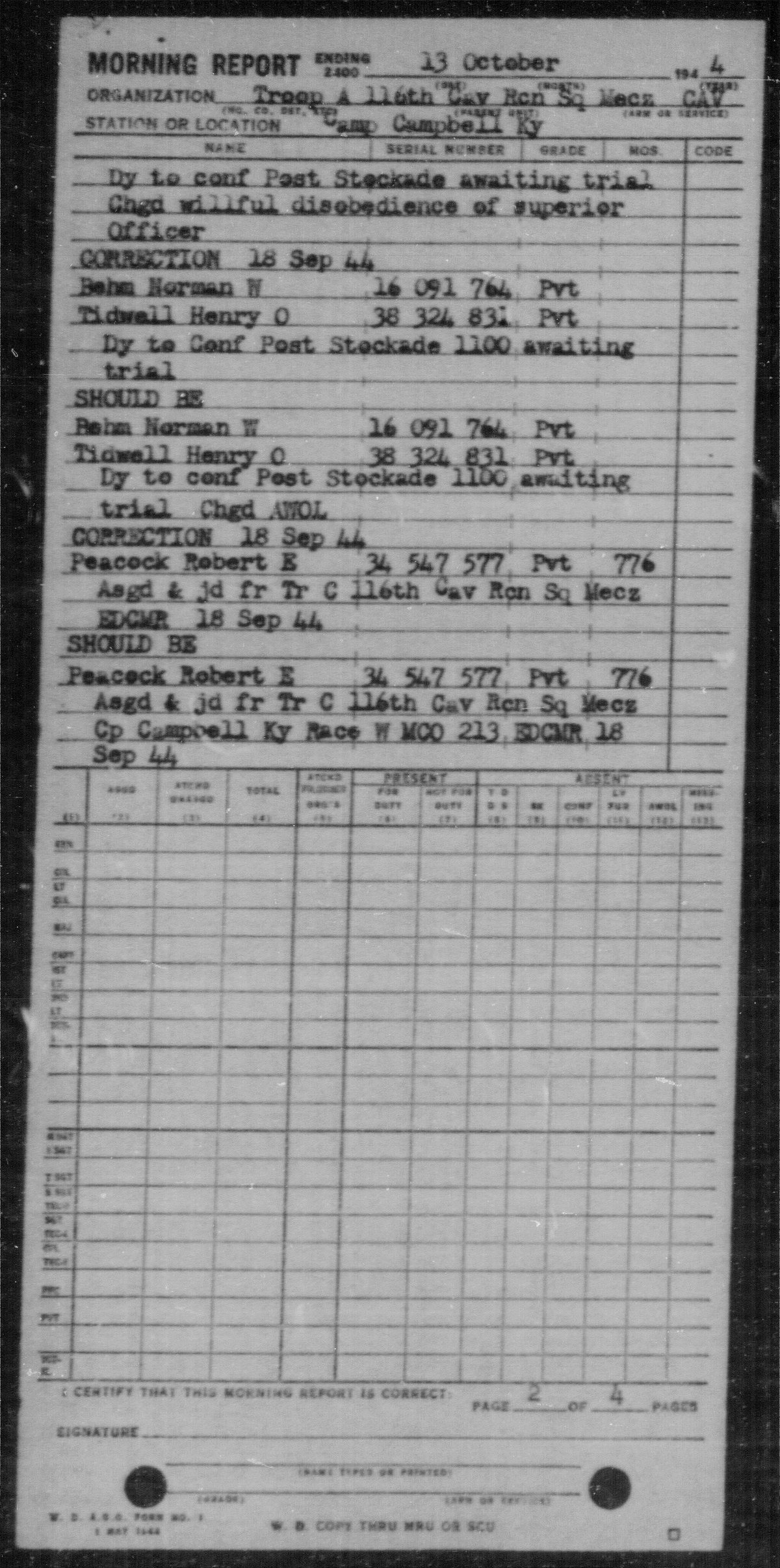
October 13, 1944

Troop A confirms the September transfer

Troop A’s October 13 report corrected its entry for Robert’s September 18 assignment from Troop C. The correction repeats his name, service number, rank and radio-operator job code, and adds Camp Campbell to the description of the transfer.

This entry confirms the September assignment. It is a correction to that earlier event rather than a new movement on October 13.
scanned record
The two Peacock lines show the original September entry and its corrected wording. The entries above concern other soldiers. The yellow is ours — it marks his name and service number on the sheet.
Source: Morning Report — Troop A, 116th Cavalry Reconnaissance Squadron (Mecz) — NARA NAID 570843316, Roll 82, image 2276, 13 October 1944
Context
November 6, 1944

His unit crosses the Atlantic

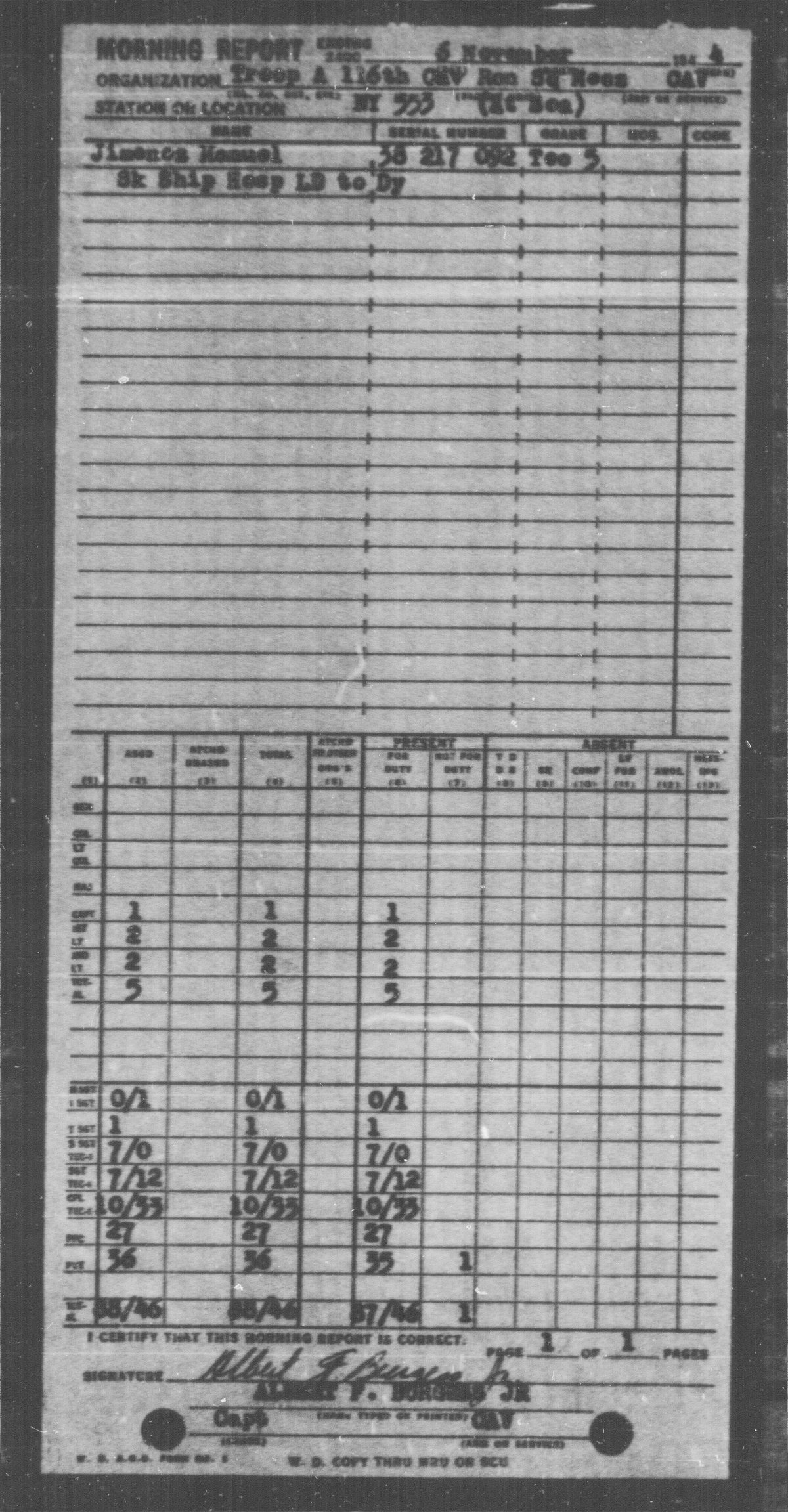
The 101st Cavalry Group’s history places the Group at Camp Kilmer, New Jersey, from October 26 to 30, then at sea from New York to Liverpool from October 31 to November 12. Troop A’s November 6 morning report independently places the troop At Sea.

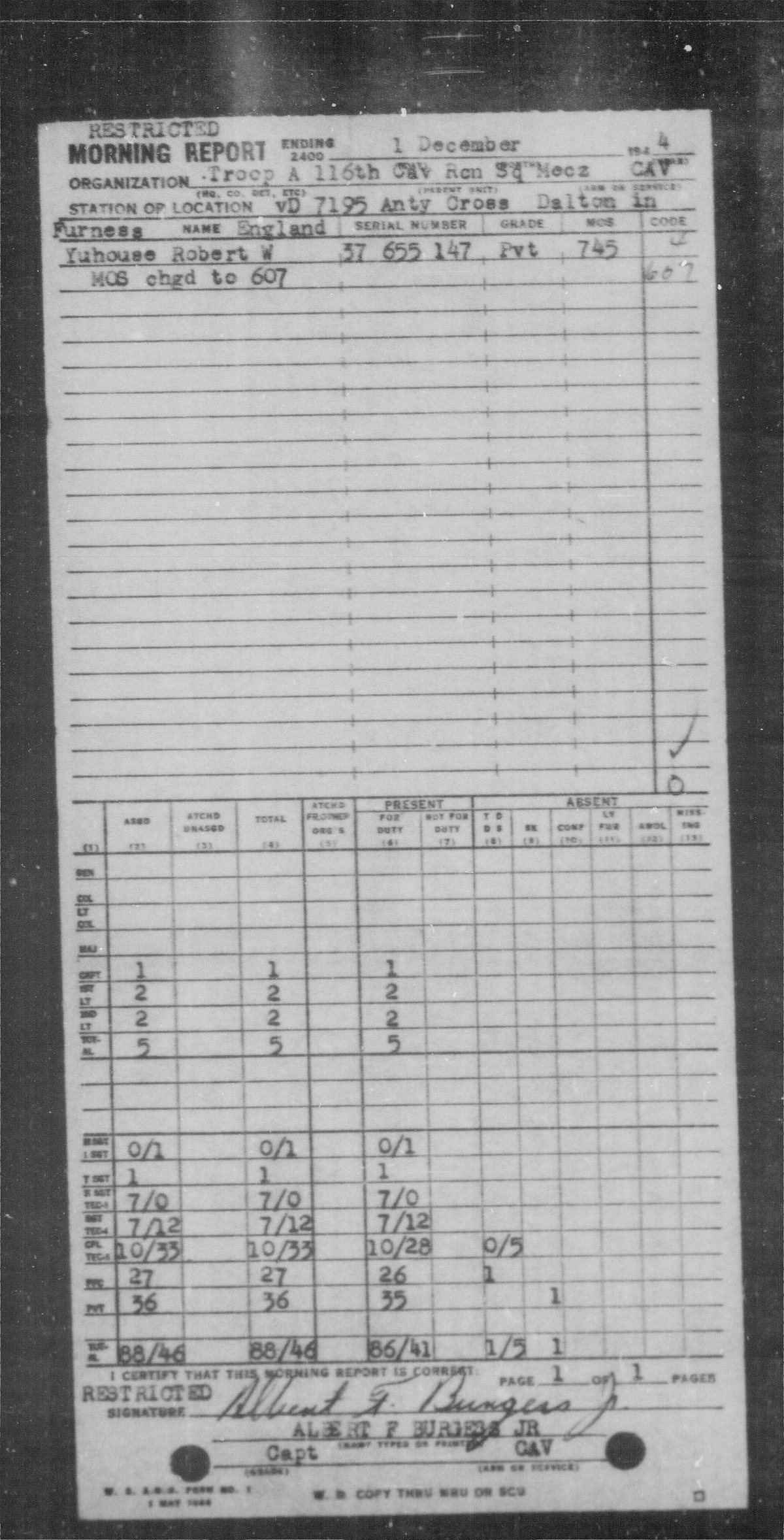
The Group then trained at Camp Anty Cross near Dalton-in-Furness, England. Troop A’s December 1 report names Anty Cross as its station.

These are unit movements. Robert’s September assignment to Troop A makes travel with the troop a reasonable inference; these two morning reports do not name him individually. The 116th Squadron belonged to the 101st Cavalry Group during this period.
scanned record
Troop A’s morning report, 6 November 1944 — station “At Sea”.
scanned record
Troop A, December 1, 1944: Camp Anty Cross, Dalton-in-Furness, England.
Source: Morning Reports — Troop A, 116th Cavalry Reconnaissance Squadron — NARA NAID 576931050, Roll 707, image 2110, November 6, 1944; NARA NAID 579231511, Roll 621, image 2029, December 1, 1944. 101st Cavalry Group official history and after-action reports, Part 2, printed page 97 (PDF page 43), record of events.
Context
January 30 – February 9, 1945

The unit moves from England to France and Germany

The 101st Cavalry Group left its English staging camp on January 30 and embarked at Southampton. Its reconnaissance troops traveled on two Liberty ships up the Seine to Rouen, landing on February 1 and reaching Camp Twenty Grand, near Duclair, early on February 2.

The Group continued through France to the Saar River front. On February 9, its headquarters and the 116th Squadron established command posts at Lauterbach, Germany.

The official history describes the route of Robert’s assigned unit. It does not identify him as a passenger on a particular ship or establish his personal arrival dates.
Source: 101st Cavalry Group official history, Part 1, printed pages 11 and 15 (PDF pages 12 and 16).
Context
February 9 – May 5, 1945

The 101st Cavalry Group in the European campaign

The 101st Cavalry Group, including the 116th Squadron, served on the Saar front under the U.S. Seventh Army. Its report counts eighty-five consecutive days in the line, from February 9 through May 5, 1945. During April and early May, the Group supported the 12th Armored Division’s advance into southern Germany.

The history specifically names Troop A in the advance near Diessen. On April 29, the troop captured bridges over the Ammer intact.

These events describe the unit’s wartime role. They provide context for Robert’s Troop A assignment without attributing a particular battle action to him.
Source: 101st Cavalry Group official history, Part 1, opening campaign narrative; 101st Cavalry Group official history and after-action reports, Part 2, printed pages 69–70, 81–87 and 95 (PDF pages 15–16, 27–33 and 41).
Context
May 8 – 10, 1945

The squadron’s missions as the war ends

The Group’s May report describes two missions led by Major Edward French of the 116th Squadron. His platoon accepted the surrender of Field Marshal Albert Kesselring at Saalfelden, Austria.

After being relieved of that duty on May 10, French and his platoon were ordered to Bad Gastein, where they took Japan’s ambassador to Germany, Hiroshi Oshima, and his entourage into custody.

These were missions of Robert’s squadron. The report does not identify Robert among the participants.
Source: 101st Cavalry Group official history and after-action reports, Part 2, printed pages 85–87 and Major French’s report, pages 89–91 (PDF pages 31–33 and 35–37).
Confirmed — Service record
November 21, 1945

Army service ends

The Veterans Administration’s death-file extract gives November 21, 1945, as Robert’s discharge date, closing more than two and a half years of Army service.

He is remembered on his military grave marker as a Technician Fifth Grade, an enlisted Army technical rank. The published Troop A roster also lists Tech. 5 Peacock, Robert E.
Source: VA BIRLS Death File: selected-field transcription; VA grave marker shown below; Tracking the 101st: Troop A roster, roster compiled from Lieutenant Colonel Hubert C. Leonard’s papers.
Confirmed — Record
October 16, 1988

Remembered at Greenlawn Cemetery

Robert Earl Peacock died on October 16, 1988, at the age of sixty-four. He is buried at Greenlawn Cemetery in Jacksonville, Florida.

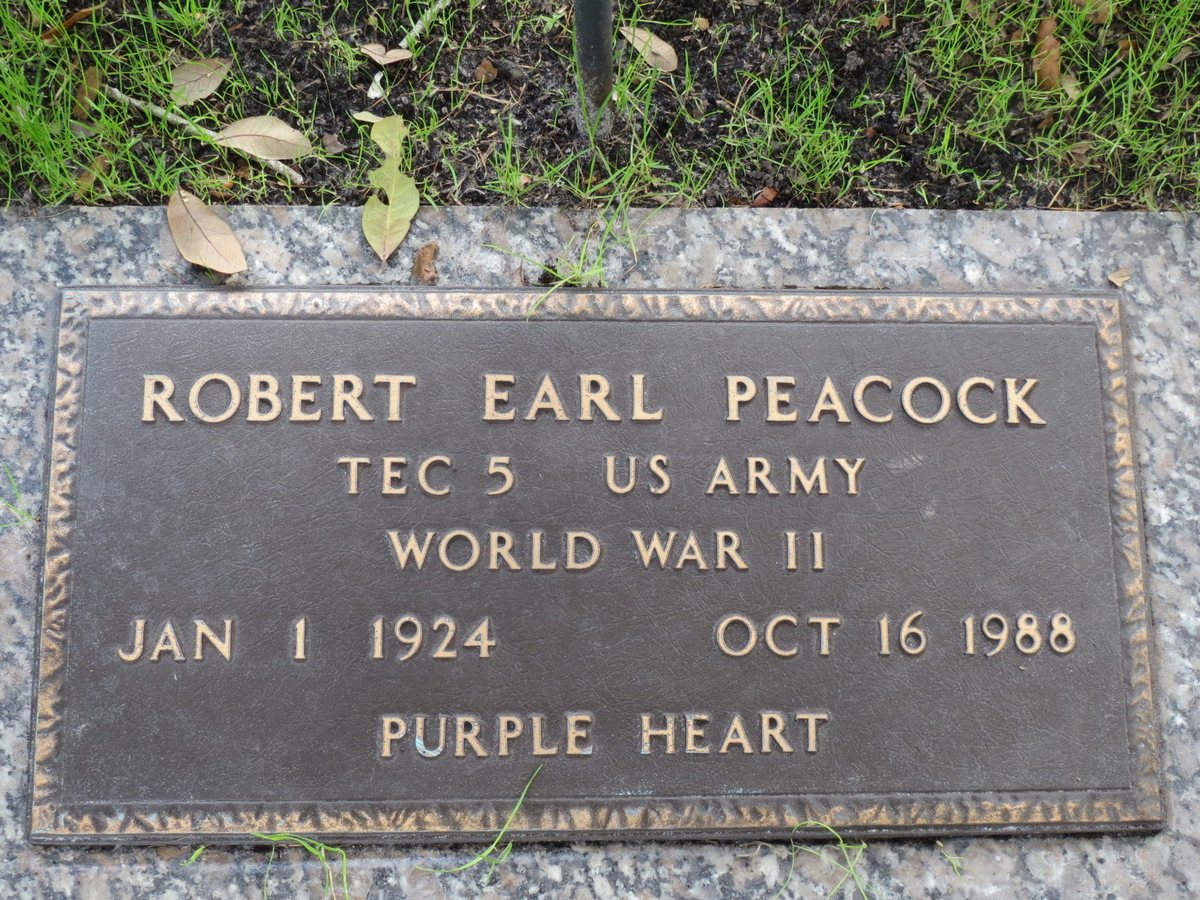
His military marker preserves his name, Army service, rank and Purple Heart: Robert Earl Peacock · Tec 5 US Army · World War II · Jan 1 1924 · Oct 16 1988 · Purple Heart.

The Purple Heart honors a wound received in wartime service, and the marker is direct evidence of the decoration. His son Mark also named the Purple Heart in the family tribute submitted to the National World War II Memorial Registry.
scanned record
His grave marker at Greenlawn Cemetery, Jacksonville, names his Army rank and Purple Heart.
Source: VA grave marker, Greenlawn Cemetery, photograph shown here; VA BIRLS Death File: selected-field transcription; Find A Grave memorial 140427398; family tribute by Mark A. Peacock, National WWII Memorial Registry, honoree 1710312; obituary of his brother Theron Henry “Hank” Peacock, Florida Times-Union, July 2006, which lists “Robert Peacock” of Jacksonville among the brothers who preceded him in death — Legacy.com.